

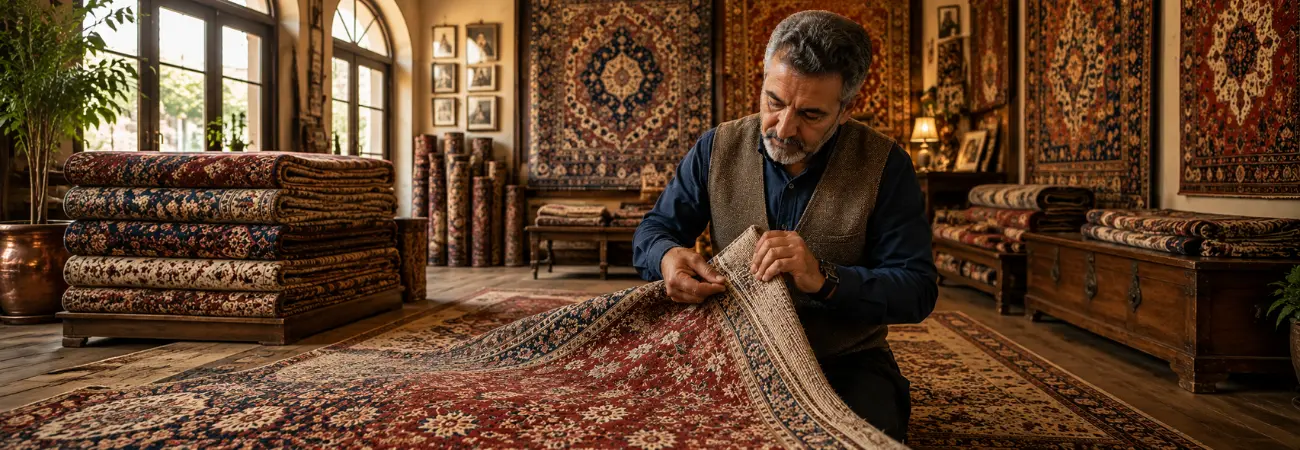
Walk into any carpet showroom and the pitch starts immediately — handmade, hand-knotted, authentic. Every piece, every shelf, every price point. But flip the rug over and what you find on the other side doesn’t always match what you just heard.
Machine-made and semi-handmade pieces share floor space with genuine hand-knotted work at surprisingly similar prices. Sometimes it’s deliberate. Sometimes dealers themselves don’t fully know what they’re carrying. Either way, the burden lands on the buyer.
Here’s the thing — a real handmade carpet doesn’t hide what it is. The knots are physically there on the back, slightly uneven, proof of every hour spent at a loom. The fringe grows from the foundation because that’s how the carpet was actually built. This handmade carpet buying guide covers everything you need to know before spending a rupee.
How to Tell if a Carpet is Handmade?
Identifying handmade carpets starts with understanding that “handmade” is not one single thing.
- Hand-knotted — the real deal. Every knot tied individually on a loom, row by row. A medium carpet takes six months. A fine Kashmiri silk piece can take close to two years.
- Hand-tufted — a gun punches yarn through canvas, then fabric gets glued over the back to hide the construction. Looks similar from the front. Not the same object.
- Hand-woven — a different technique again, often flatweave, no pile.
An unusually affordable “handmade” carpet should immediately make you suspicious.
How to Identify a Handmade Carpet on the Spot?
Here are the clearest signs of a handmade carpet — no tools, no expertise required:
Flip It Over
This takes four seconds and saves more money than anything else.
- On a real hand-knotted carpet, the back shows a faint impression of the front pattern — formed by knot structure, not printed.
- The surface feels slightly uneven, almost bumpy — those are individual knots.
- Machine-made carpets hide everything under latex or fabric mesh — smooth, flat, uniform.
If a seller gets flustered when you ask to flip a carpet, that reaction alone is worth paying attention to.
Check the Knots
Learning how to identify hand knotted rugs comes down to one thing — irregularity. Slight variation is the sign of quality, not a flaw.
- Knot spacing shifts slightly between rows.
- Tension varies across the surface.
- Running fingers across the back feels like raised individual points — not a flat sheet.
- Machine-made backs feel completely smooth — once you’ve felt both, you won’t confuse them again.
Pull the Fringe
- On a genuine carpet, fringe is the exposed ends of the warp threads — structurally part of the carpet.
- Pull one strand gently — it should feel firmly attached.
- Machine-made fringe is stitched or glued on afterward — one tug usually makes this obvious.
Fold It
- A natural wool carpet folds without resistance — soft, flexible, no rigidity.
- If it fights back when folded, there’s a hidden backing underneath.
- Synthetic pile feels soft at first but flattens permanently under daily foot traffic.
- Real wool has springiness — firmer, but it recovers.
Handmade Rug vs Machine Made Rug — at a Glance
Understanding the difference between handmade and machine-made rugs is the foundation of smart carpet buying. Here’s how they compare:
| Feature | Handmade Carpet | Machine-Made Carpet |
| Construction | Knotted by hand, one knot at a time | Manufactured using machines |
| Knot Pattern | Slightly irregular and unique | Perfectly uniform |
| Fringe | Part of the carpet foundation | Stitched or glued separately |
| Materials | Wool, silk, cotton, or natural fibres | Mostly synthetic materials |
| Back Surface | Uneven knot structure visible | Smooth latex or mesh backing |
| Lifespan | Can last decades or even a century | Usually shows wear within 10 years |
| Resale Value | Often holds or increases in value | Depreciates immediately after purchase |
In the hand-knotted rug vs machine-made rug comparison, the back of the carpet is where the difference is impossible to fake.
What Actually Determines Authentic Handmade Carpet Quality?
Here is what determines the authentic handmade carpet quality:
Knot Density
Knots per square inch — KPSI — tells you how fine and durable a carpet is. This is central to how to identify hand knotted rugs on the spot.
- Entry-level handmade: 40–80 KPSI
- Fine Kashmiri silk: can exceed 500 KPSI
Wool, Silk, or Synthetic
Wool:
- Most common in genuine handmade carpets and genuine handmade Indian rugs.
- Slightly waxy feel from natural lanolin.
- Resists staining, improves with age.
- A 30-year-old wool carpet in daily use looks better than it did when new.
Silk:
- Used in finer pieces including authentic Kashmiri silk carpets.
- Real silk carpet identification is straightforward — rub the pile firmly for a few seconds.
- Real silk generates warmth from friction.
- Viscose (“art silk”) doesn’t — this test works every time.
Synthetic:
- Almost exclusively machine-made.
- Feels fine initially, compresses and flattens fast.
- No aging qualities whatsoever.
Natural Dyes vs Chemical Dyes
| Dye Type | Natural Dyes | Chemical Dyes |
| Common Sources | • Madder root • Indigo • Pomegranate • Walnut | • Synthetic chemical pigments |
| Colour Appearance | • Soft tones • Rich depth develops over time | • Bright appearance • Perfectly flat colour initially |
| Colour Variation | • Slight variations are natural • Adds authenticity and character | • Uniform colour throughout |
| Ageing Process | • Colours deepen beautifully over decades | • Colours often fade unevenly |
| Sunlight Response | • Gradual and even fading | • Patchy fading can appear |
| Authenticity Indicator | • Minor inconsistencies suggest hand-dyeing | • Zero variation may indicate synthetic production |
Where Authentic Handmade Carpet Was Made?
Origin matters more than most buyers realize. Whether you’re looking at authentic oriental rugs or genuine handmade Indian rugs, where a carpet comes from shapes everything about it.
- Kashmir — Silk-on-silk weaving at extraordinary knot densities. Authentic Kashmiri silk carpets carry a Geographical Indication tag for added authentication.
- Jaipur — Bold geometric patterns, well-dyed wool, more accessible pricing. One of the best sources for genuine handmade Indian rugs.
- Iran — Historical benchmark for authentic oriental rugs. Antique pieces actively traded in collector markets worldwide.
- Afghanistan — Hand-spun wool, built for heavy daily use. Tribal geometric patterns with real cultural roots.
- Turkey — symmetrical double knot, firmer pile, bold geometric patterns. Authentic oriental rugs from Turkey hold up exceptionally well in high-traffic rooms.
Mistakes That Cost People Real Money
Here are the mistakes that cost people real money:
Trusting labels without checking the carpet:
- “Hand-knotted,” “pure wool,” “authentic” cost nothing to print
- Nobody verifies these before attaching them to a carpet
- Read the label, then look at the actual carpet
Never flipping it over:
- The front looks good by design
- The back shows how to identify a handmade carpet versus a machine-made one
- Seller reluctance to flip is itself informative
Choosing by softness:
- The softest carpet in the showroom is usually the shortest-lived
- Synthetic fibers compress fast under real daily use
- Real wool has slight resistance — firmer, but it lasts
Accepting vague answers about origin:
- A seller handling genuine pieces knows the specifics without thinking
- Shifting or vague answers about region and workshop are a red flag
Questions to Ask Before Paying?
- Which region and workshop did this come from — specifically?
- Is the fringe structural or attached afterward?
- What are the fibers — and if silk, real silk or art silk?
- Was this hand-knotted or hand-tufted?
- Is there documentation of origin or a GI tag?
How to Tell if a Rug is Antique?
Knowing how to tell if a rug is antique requires a few additional checks beyond standard handmade identification. Real age leaves specific physical marks that are difficult to fake.
- Abrash becomes more pronounced and looks completely natural — not artificially varied.
- Wool develops a low-sheen lustre new wool doesn’t have.
- Dark areas oxidize over time and sit slightly lower than surrounding pile.
- Fringe wears unevenly at the tips in ways that are hard to fake convincingly.
- Even fading across the whole field suggests decades of real light exposure.
- Patchy fading in specific areas often means artificial distressing.
For serious antique purchases, consult a specialist. Reputable restoration services can date a piece accurately from physical examination alone.
Final Word
The back of a carpet doesn’t lie. Flip it over and everything you need to know is already there — the knots, the fringe, the weight of the wool. No sales pitch required.
Most bad carpet purchases happen not because the buyer was careless, but because nobody told them where to look. The front of every carpet in every showroom is designed to impress. The back is where the real construction either holds up or it doesn’t. That’s not a feature unique to expensive pieces. It’s what honest construction does over time, regardless of price point.
Most carpet regrets don’t show up at the point of purchase. Knowing how to identify authentic handmade carpets before you buy is the only thing that reliably prevents that.
If you want to skip the guesswork entirely, Janson Carpets is worth a conversation. Based in Delhi and working as an established carpet exporter in Delhi, they know exactly what they’re selling and why — from sourcing to restoration to helping you find the right piece for a specific room and budget. Every carpet is made and tailored to your requirements, not pulled off a generic shelf.
They work across the full range:
- Kashmiri Silk Carpets
- Persian Rugs
- Hand Knotted Rugs
- Afghan Rugs
- Kilim Carpets
- Woolen Rugs
- Tribal Rugs
- Runner Carpets
- Geometric Rugs
- Antique Carpets
- Indian Carpets
- Vintage Inspired Rugs
Browse at jansonscarpets.com, visit the Delhi store in person, or call +91-9811129095.
FAQs
Q1 . How do you identify a genuinely handmade carpet?
Flip it over. The back reveals everything the front was designed to hide.
- Visible knots forming the pattern on the reverse
- Slightly uneven surface from individually tied threads
- Fringe growing directly out of the foundation
- Smooth latex backing means it was not hand-knotted — regardless of the label
Q2 . Are handmade carpets worth the price?
Yes. For somewhere temporary, probably not.
- Outlasts machine-made pieces by several decades
- Looks better with age rather than deteriorating
- Holds and often increases in value over time
- One of very few home purchases that pays for itself in the long run
Q3 . Why do genuine handmade carpets cost so much?
Time, primarily. There is no faster version that produces the same result.
- A medium-sized carpet takes a minimum of six months
- Fine Kashmiri silk pieces take up to two years
- Wool is often hand-spun, dyes prepared in separate batches
- Every single knot placed individually at a loom
Q4 . What should I check when buying a handmade carpet online?
Ask for specific visuals before committing to anything.
Q5 . How do I spot a genuinely antique carpet?
Real age leaves specific physical marks that are difficult to fake.
Q6 . Does the region a carpet comes from actually matter?
Significantly. Origin shapes construction, materials, aging, and long-term value.
- Kashmir — authentic Kashmiri silk carpets with extraordinary knot density and GI tag authentication
- Iran — Historical benchmark for authentic oriental rugs and design complexity
- Afghanistan — hand-spun wool, built for heavy use, seriously undervalued
- Turkey — symmetrical double knot, bold geometry, exceptional durability
- Jaipur — genuine handmade Indian rugs at more accessible price points
A seller who knows the specific region and workshop without hesitation is a seller worth trusting