

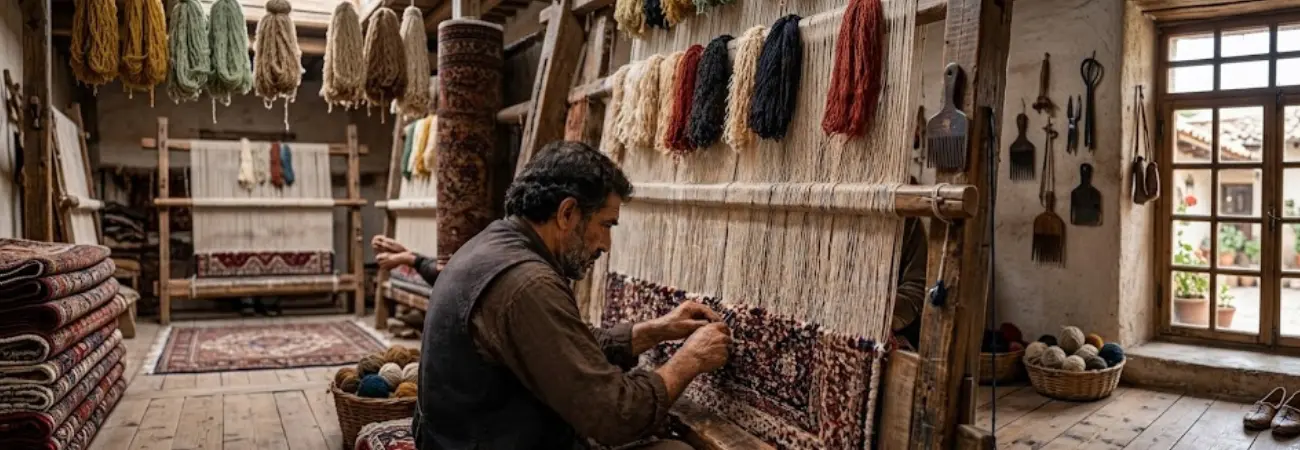
Move over factory-perfect rugs and copy-paste designs! We just found the kind of carpets that are quietly rewriting what luxury underfoot looks like in 2026. If you’ve ever walked into a room and felt your eyes drop — not to the furniture, but to a richly detailed, impossibly intricate carpet that seems to hold stories in every thread, you’re not imagining it.
Hand-knotted wool carpets aren’t just décor anymore — they’re conversation starters, heirlooms and a little bit of rebellion against mass production. Each knot is patiently tied by hand and every pattern takes shape through the weaver’s memory and instinct rather than the predictability of machines and what you’re left with is not just a carpet but a piece that carries its own identity that ensures that no two are ever truly alike.
These handmade wool rugs call forth something that many houses have been gradually stripping themselves of without quite understanding it: a form of character that seems intimately personal and truly lived on.
Benefits of Wool Rugs: What makes the Handknotted Carpet Rugs Unique?
A weaver sits down, stretches warp threads, and begins tying — one knot at a time, by hand, across months. Sometimes well over a year. There’s no express version of this process. No shortcut that leaves the result intact.
| Feature | Hand-Knotted Wool Carpets | Machine-Made Carpets |
| Craftsmanship | Handmade by skilled artisans | Manufactured by machines |
| Durability | Can last decades (excellent wool carpet durability) | Lower lifespan |
| Material Quality | Premium natural wool | Often synthetic |
| Design Uniqueness | One-of-a-kind patterns | Mass-produced designs |
| Investment Value | Appreciates or retains value | Depreciates quickly |
Durability That Outlasts Most of What You Own
Most home purchases carry an unspoken timeline — sofa, curtains, rug, replace, repeat. A handmade rug from India steps outside that cycle entirely. Buy one good one and the replacement question simply stops arising.
- Wool’s built-in recovery — Each fibre works a bit like a compressed spring, bouncing back after every step. Even in the most-used corridor in your house, it won’t develop that flat, spent look that finishes luxury wool carpets within a few years.
- Heirlooms, not hand-me-downs — These are the Handmade Indian carpets that grandchildren inherit still looking worth keeping — pile intact, colours warm, structure holding. Not a marketing claim. Families across three generations have put that to the test.
- Colour that doesn’t give up — Natural wool takes dye deeply and holds it. The colours you chose in the showroom will still read true twenty years on, in a sun-filled room, without drifting into something vaguely washed-out.
The best wool carpet store offers durable rugs that last for around fifty to a hundred years.
Warmth and Comfort That’s Hard to Explain Until You Feel It
Stepping onto a magnificent silk on silk carpet on a cold morning is one of those things that doesn’t translate well into copy. It isn’t just softness — it’s a kind of considered comfort, the floor actually working in your favour for once.
- Natural insulator — Wool fibre traps millions of air pockets that act as natural insulation, keeping the floor warmer in winter and softly shaving the heating bills.
- Rooms are quieter — Wool absorbs rather than reflects sound. An interior with hand-knotted wool underfoot just feels grounded — footsteps are muffled, voices don’t carry quite as far and the general buzz of day-to-day noise softens some of its bluntness.
- The shift is immediate — Put a wool carpet in a room and something in the atmosphere changes. The warmth, the softness, the quiet calm — they work on people before anyone has thought to analyse why.
A Pattern Language That Doesn’t Date
Rugs trends 2026 have an encoded expiration date somewhere in their make-up. They become a now and then they aren’t anymore. The lexicon of premium handmade carpets – medallions, geometrics, botanicals – has been deemed beautiful cross-culturally and across time, and it continues to find a home naturally in contemporary spaces without asking to be understood.
- Bold Geometric Rugs — Patterns that were fully formed hundreds of years ago are just as purposeful today, whether they’re on flats in minimal or layered traditional interiors.
- Depth of colour — Natural dyes create colours that subtly vary up and down each strand — wool takes dye a little differently fibre to fibre, adding a layer of complexity to the depth of colour synthetic dyes simply can’t replicate.
- Anchors the room — The right-hand knotted rug doesn’t compete with the rest of the space. It gives furniture, lighting and textiles something solid to organize themselves around. Rooms start to look edited, not stuffy.
- Works in most contexts — Whether a space is stripped back or fully layered, hand-knotted carpet tends to find its place without effort. It lifts what’s around it rather than competing with it.
Stain and Fire Resistance — No Chemical Treatments Required
Wool protects itself. It arrives ready-equipped, which is one of those quiet but significant edges over synthetics that need factory coatings to reach a fraction of the same performance.
- You get time to react — Liquid sits on the surface for a while before it starts to penetrate, so you’re not in a panic the moment something goes over. Blot it calmly and most of it comes away clean.
- Hard to ignite — Wool needs far more heat to catch than synthetic materials — which are petroleum-based and respond to flame in ways that are genuinely alarming. Wool resists ignition. Remove the heat source and it stops burning without smouldering or spreading.
Environmental Credentials That Are Actually Real
“Sustainable luxury” has been stretched so far it’s nearly meaningless. With hand-knotted wool, the environmental case isn’t positioning — it’s just what the material factually is.
- Renewable by nature — Sheep are shorn once a year without harm and the fibre regrows on that same cycle, indefinitely. No extractive process. No resource being depleted.
- Returns to earth — When a wool carpet’s long life finally ends, it breaks down naturally in soil and leaves nothing behind. Synthetic Indian carpets and rugs will outlast everyone alive today in a landfill somewhere.
- No hidden chemicals — Hand-knotted wool skips the petroleum-based compounds running through mass-produced alternatives — materials that don’t stop existing just because they’re buried under your furniture.
- Directly supports artisan families — The money reaches the people who made it, not a factory floor. For many weaving communities, this craft is what keeps everything else going.
The Economics Make More Sense Than They First Appear
The upfront price looks steep until you actually do the maths. After that, it looks quite different.
- Decades of use — A well-kept hand-knotted wool carpet stays beautiful and fully functional for fifty years or more. Machine-made alternatives can’t approach that at any price, and most need replacing well before the ten-year mark.
- Cost per year — Spread the purchase price across five or six decades of daily use and the annual figure becomes surprisingly easy to justify. Handmade antique carpets that require replacement every eight to ten years start to look like the more expensive choice.
- Doesn’t depreciate — Almost everything brought into a home loses value immediately and continues to drop. A quality hand-knotted carpet is one of the few exceptions — it holds its worth and, in many cases, builds on it.
- Can appreciate significantly — Fine carpets from established weaving regions that have tracked upward in value over time. It’s closer to acquiring serious craft than standard home shopping.
Someone Made This. That’s Worth Saying.
Behind every hand-knotted carpet is a person who spent months — sometimes well over a year — on a piece they’d never keep, always intended for someone else’s home. That changes what you’re actually buying.
- Knowledge passed through generations — These techniques were developed and refined across centuries of master weavers. They carry aesthetic judgment and physical knowledge that no pattern software replicates.
- Real time investment — A single handmade runner carpet can take more than a year to complete. Every knot placed by hand, every design decision made in the moment with no ability to undo it. The attention shows in the result.
- Genuinely one of a kind — Because every choice passed through a human mind, no two carpets are identical. The one in your home is the only one like it anywhere. That’s not a marketing angle — it’s a fact of how these things are made.
- Imperfection as proof — Those subtle colour shifts, the slight variations in pattern — they’re not mistakes. They’re evidence of a human mind working carefully through something genuinely difficult. That’s what makes it feel alive rather than produced.
How to Choose the Right Hand-Knotted Wool Carpet?
The right handmade Kashmiri rug for your home exists — finding it just takes some honest thinking about your space before you start browsing.
Get the Scale Right
Bigger than you think, almost always. A little Kashmiri Rug looks like an afterthought — the furniture is just outside it rather than being anchored to it. You want the rug to be big enough to anchor the room but you don’t want to see the entire floor around the edge of the rug so that the floor can breathe and the rug can be seen. Check out our blog on the right rug size for every room for more insights.
Work with What’s Already There
Before you fall for a color in a showroom, go home and look at your walls, your furniture, at your natural light at different times of day. A rug that battles its environment never really makes peace with it. The best ones don’t call attention to themselves – they make everything else in the room appear more deliberate.
Check the Knot Density
Flip the hand-knotted rugs for the home. A denser, more tightly woven back indicates more knots per square inch — better workmanship, more detailed designs, and a construction that holds up for decades beyond an ordinary one. It’s not the only thing that matters, but when you’re trying to differentiate two items and can’t quite tell what sets them apart, that’s most likely where the answer is.
Buy from someone who can actually explain it
Where did it come from? Made by whom? Why is the price what it is? If a seller can’t give you specific answers to those questions, that’s something to take notice of. A rug of this importance should have a resaler who knows what they’re selling — and isn’t guessing.
Conclusion
A hand-knotted wool carpet gives something back every day — in warmth, in beauty, in the particular satisfaction of owning something made with genuine skill and care. It’s not a trend piece. Not something you’ll reconsider in three years. It’s something your home grows around, something that gets handed on. As a leading carpet shop in India, Janson Carpet treats every carpet in our collection with exactly that in mind. We have a collection of the following carpets:
- Wool Rugs
- Afghan Rugs
- Tribal Rugs
- Kashmiri Silk Rugs
- Kilim Carpets
- Bold Geometric Rugs
- Persian Rugs
- Vintage-inspired rugs
So what are you waiting for? Explore more at jansonscarpets.com, visit their Delhi store, or call +91-9811129095.
FAQs
Q1 . Are hand-knotted wool carpets worth the price?
Yes. Here’s why the numbers actually work in your favour:
- The wool carpet’s durability stretches across five to six decades of daily use.
- Beauty holds without fading, flattening, or dating.
- Value retention means it won’t depreciate like most home purchases.
- Cost per year, spread across fifty-odd years, is lower than most people expect.
Q2 . How long do hand-knotted wool carpets last?
Anywhere between fifty and a hundred years with basic care — and that’s not an exaggeration. A few reasons families end up passing these down:
- The knot density keeps the structure intact even under heavy daily use.
- Wool fibres don’t break down the way synthetic materials do over time.
- Colours hold because natural dye bonds deeply into each fibre.
- Unlike machine-made rugs, there’s no backing or adhesive to degrade.
Q3 . Do wool carpets require high maintenance?
Not really. The routine is straightforward:
- Vacuum regularly to lift surface dust and keep the pile fresh
- Rotate occasionally if one area takes more foot traffic than others
- Professional clean every few years — once, maybe twice a decade
- Spot-treat spills promptly; lanolin buys you time before anything sets
Q4 . Are hand-knotted wool carpets good for luxury interiors?
They’re the benchmark. Serious interior designers consider a fine hand-knotted carpet the most powerful element in a well-designed room — not an accessory, but the foundation everything else is built on.