

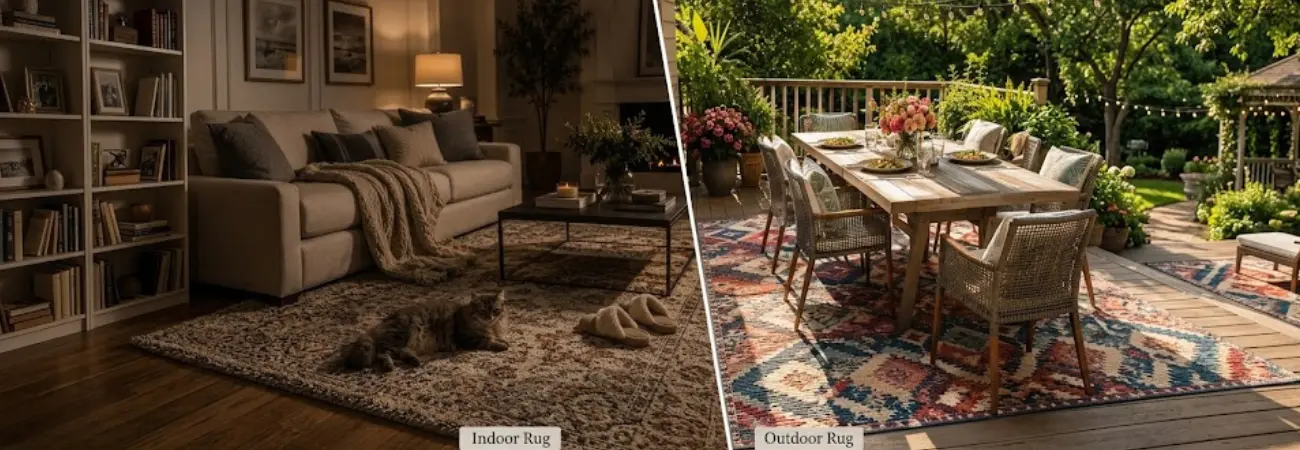
Nobody thinks about this until they’ve made the mistake. A wool rug left on the patio through one monsoon season, and suddenly something that cost real money is moldy, warped, and done — not because it was poorly made, but because it was the wrong rug in the wrong place.
Get it wrong and you’re replacing a rug within a season. Get it right and you’re still looking at the same piece twenty years later. This guide delved into the key differences between indoor rugs vs Outdoor Rugs to help you choose the best one.
Indoor Rugs vs Outdoor Rugs: Key Differences at a Glance
Here is a difference between Indoor rugs vs Outdoor Rugs:
| Feature | Indoor Rugs | Outdoor Rugs |
| Materials | • Wool • Cotton • Silk | • Polypropylene • Polyester • PET |
| Texture | • Plush • Soft • Varied pile | • Flat weave • Low pile • Slightly coarse |
| Durability | • Lasts decades indoors • Fails quickly outside | • Built for weather exposure • Heavy-traffic resistant |
| Maintenance | • Vacuum regularly • Rotate periodically • Professional cleaning recommended | • Shake clean • Hose wash • Air dry |
| Moisture Resistance | • Low resistance • Mold risk when wet | • High resistance • Quick-drying • Mold-resistant |
| Design | • Intricate patterns • Rich textures | • Simpler designs • UV-stable colors |
| Best Placement | • Living rooms • Bedrooms • Dining areas | • Patios • Decks • Balconies • Pool areas |
| Price | • Wide price range • Handmade rugs command premium pricing | • Generally affordable • Practicality-focused pricing |
Indoor Rugs vs Outdoor Rugs: The Differences You Should Look Into
Here are the key differences of Indoor rugs vs Outdoor Rugs you should look at:
1. Indoor Rug materials vs Outdoor rug materials
Indoor rugs are made from natural fibers refined over centuries:
- Wool — warm, durable, handles foot traffic year after year without losing what makes it worth having
- Cotton — breathable, casual, washes easily, works well in everyday spaces
- Silk — catches light unlike anything else; belongs in low-traffic formal rooms where it won’t get ground down
Outdoor rugs exist to solve a different problem entirely. Polypropylene doesn’t rot, doesn’t absorb water, holds up under UV exposure that would destroy wool within a few months.
2. Texture
Step onto a quality wool rug barefoot and the difference is immediate. Real depth, cushioning, that give underfoot that makes a room feel finished rather than just filled. It’s not something you notice consciously every day — until you’re somewhere without it and you feel the absence.
Outdoor rugs are flat because that’s the right call for where they live. Thick pile traps water, takes too long to dry, and mold gets in quietly before most people realize there’s a problem. Low pile drains fast, handles dirty shoes without holding the mess, dries between uses.
3. Durability
A well-made indoor rug can handle years of daily use inside a protected home.
It holds up to the weight of furniture, regular foot traffic, and daily wear and tear of a household without sagging.
- Good quality indoor rugs can last for many years with proper maintenance.
- some hand made indian rugs are strong enough to last through generations.
- Indoor rugs do not stand up well to outdoor use.
- Natural dyes are faded by constant UV exposure more quickly than most people realise.
- A rug that looks bright in March may look pale in October.
- Rain, humidity, and dew erode fibers over time, and even moisture from your breath can contribute to fiber degradation.
Outdoor rugs are built for exactly this from the ground up:
- UV stabilizers integrated during manufacturing, not surface-coated afterward
- Tight weaves that shed water rather than pulling it in
- Construction tested for sustained environmental stress
4. Maintenance
Indoor rugs need regular attention:
- Vacuum frequently — Hold the beater bar off the fringe; it shreds more from vacuuming than it does by years of foot traffic.
- Swap ends every few months so the wear evens out, rather than forming a well-worn track in the middle.
- Blot spills at once, do not rub — rubbing pushes the stain down and makes it more difficult to remove later.
- Antique or silk pieces need professional outdoor rug cleaning tips every time, no exceptions
- Watch for carpet beetles early — surface damage visible means they’ve been working for months already
Outdoor rugs ask very little:
- Shake out regularly, before they look visibly dirty
- Hose down with mild soap and a soft brush for anything stubborn
- Dry completely before rolling or storing — skipping this is why most outdoor rugs smell like mold when they come out in spring
- Bring inside for winter where possible — freeze-thaw cycles shorten lifespan more than people expect
5. Moisture Resistance
This is where most people get caught out. Natural fiber doesn’t just absorb rain — in humid climates, air moisture alone starts the damage if a rug can’t breathe and dry properly. Once moisture is through the fiber, mold sets in, dyes bleed and the weave breaks down from inside. By the time it’s visible on the surface, it’s usually already past saving.
Synthetics work the opposite way. Water moves through and out rather than in. After heavy rain, an outdoor rug is dry and stable again quickly, without the prolonged dampness mold needs to take hold.
6. Design Complexity
A quality wool rug purchased with care will stand the test of time and be more durable than two inexpensive ones. The look and feel of a proper rug on a floor you use day to day pays for itself in ways that are hard to quantify and easy to feel first thing every morning. High knot count and the pattern looks as crisp after thirty years as when new. Lower density and it starts blurring within a few years — people call it vintage at that point rather than admit it’s worn out.
Outdoor rugs are a different conversation. UV-stable dyes limit the palette. Flat weave can’t carry the detail that dense pile allows. They can look good — genuinely good in some cases — but the difference is obvious in a real room, even when photographs make them appear similar.
7. Price
Outdoor rugs — buy for material quality and ignore everything else. A solid polypropylene rug at a fair price beats an expensive trendy synthetic every time. Don’t pay for branding on something that lives outside.
Indoor rugs are where the decision compounds. A quality wool rug bought carefully outlasts two cheap replacements. A genuine handmade piece, properly sourced and maintained, can last longer than the person who bought it.
Difference between Indoor and Outdoor Rugs: Where Each Rug Truly Belongs
Indoor rugs belong in:
- Bedrooms — Wool or cotton, always. The first steps of the morning deserve something underfoot worth feeling. Size it generously past the bed on both sides — anything smaller makes the whole room look unconsidered.
- Living rooms — Wool handles years of daily life without losing its character. The most common mistake is buying too small. If sofa legs are floating off the edge, the room looks incomplete regardless of what else is in it.
- Corridors — A carefully selected flat-weave runner can make the movement from room to room feel intentional. Thoroughfares experience the most foot traffic and are the least thought-about design-wise in the majority of homes.
- Home offices – A rug beneath your desk muffles echoes more effectively than many sound-damping panels and helps a work space corner feel finished and purposeful rather than thrown together.
Outdoor rugs belong in:
- Patios and decks — Polypropylene, sized correctly for the furniture on it. Too small always looks worse than no rug at all.
- Pool areas — Quick-drying, chlorine-tolerant, non-slip. A surface that traps water near bare feet fails on safety and practicality simultaneously.
- Covered porches and balconies — UV-stable colors still matter even under partial cover. Fading moves faster in these spaces than most people account for.
- Mudrooms, kids’ rooms, laundry rooms — Outdoor rug used indoors, no justification needed. Hose it down, replace it when the time comes, and spend the savings somewhere it actually matters.
Handmade Rugs — Why They’re Different?
What makes hand-knotted rugs different:
- Built knot by knot over months — sometimes close to a year for larger pieces
- More knots per inch means finer detail, sharper pattern edges, stronger structure
- High knot count rugs look as crisp at thirty years as the day they arrived
- Lower density pieces blur and soften within a few years — people call it charm, it’s just wear
Kashmiri silk carpets
- Silk in both the foundation and the pile — detail most weavers won’t attempt
- Catches light in a way wool doesn’t come close to
- Value holds or grows over time — families pass these down, they don’t sell them
How to Take Care of Your Rugs?
Here is how to take care of your rugs:
Indoor rugs:
Vacuum regularly, beater bar away from the fringe
Rotate every few months for even wear
Blot spills immediately, never rub
Professional cleaning for antiques and silk — every time
Watch for carpet beetles before the damage becomes visible on the surface
Outdoor rugs:
Shake out regularly, don’t wait for visible dirt
Hose down with mild soap when needed
Dry completely before storing — the most skipped and most important step
Bring inside for winter storage where possible
Final Thoughts
Indoor spaces need natural fibers — comfort, depth, and craft that comes from centuries of refinement. Outdoor spaces need synthetics — built for weather, moisture, UV, and sustained environmental stress that finishes natural fiber rugs in a single season.
The mistake most people make isn’t choosing badly. It’s not thinking about the distinction at all until there’s already a damaged rug or a room that never quite came together. A little thought before the purchase saves real money and real frustration.
For homeowners looking for pieces that earn their place for decades, Janson Carpets brings deep expertise as a carpet exporter in Delhi — offering custom pieces, professional restoration, and genuine guidance across
- Kashmiri Silk Carpets
- Persian Rugs
- Hand Knotted Rugs
- Afghan Rugs
- Kilim Carpets
- Woolen Rugs
- Tribal Rugs
- Runner Carpets
- Geometric Rugs
- Antique Carpets
- Indian Carpets
- Vintage Inspired Rugs
Everything crafted and personalised to your exact requirements. Visit jansonscarpets.com, come into the Delhi store, or call +91-9811129095.
FAQs
Q1 . What is the actual difference between Indoor rugs vs Outdoor Rugs?
The real difference is simple: materials and purpose. Indoor rugs are crafted for comfort and beauty in indoor environments and typically are made with natural fibers. Outdoor rugs are woven from synthetic fibers that are treated to resist moisture, UV rays and abrasion. One is for indoor living, the other for outdoor living and enduring the elements.
Q2 . Can an indoor rug go outdoors?
No. Natural fibers absorb moisture — not just rain but humid air — and once it works through the fiber, mold follows and the damage doesn’t reverse. UV exposure alone breaks down natural dyes faster than most expect. One season outside and it’s usually done.
Q3 . How long do outdoor rugs last?
Three to five years with basic care. A well-made polypropylene rug brought in for winter and dried properly after rain can go longer. A cheap synthetic left outside year-round in a wet climate might not survive two seasons.
Q4 . Can outdoor rugs go mouldy?
Yes, if neglected. Even synthetics develop mold when stored damp or left sitting wet in poorly ventilated spots. Airflow underneath and proper drying after rain prevents most of it.
Q5 . What is the Best material for an outdoor rug?
Polypropylene. Moisture-wicking, stain-resistant, fade-resistant, and reliable across seasons. Recycled PET if sustainability genuinely matters to you.
Q6 . What is the Best material for an indoor rug?
- Wool — right for most rooms that see regular use
- Cotton — casual spaces, washes easily
- Silk — formal, low-traffic areas only
- Nylon or polyester — where budget is a real constraint