

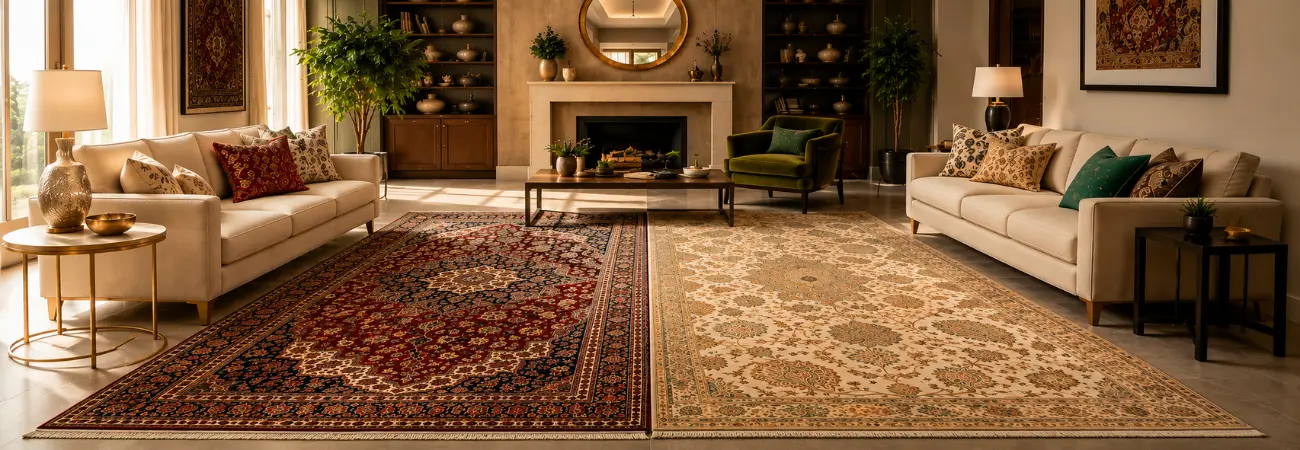
Have you ever been in a rug store looking at two rugs that both look hand knotted and gorgeous, but one is twice the price of the other? That’s generally what starts the Persian rug vs Kashmiri carpet debate itself, not so much as an academic comparison discussion but a person standing in a showroom trying to figure out what they’re really paying for.
This isn’t about picking a winner in the Persian carpet vs Kashmiri carpet debate. It’s about working out what fits your house, your daily routine, and your budget, since whatever you buy might sit in your living room for the next three decades. Some people are drawn to handmade Persian rugs for the heritage story. Others want handmade Kashmiri carpets purely for the silk work. Neither instinct is wrong. It usually just comes down to a few practical questions rather than which name sounds more impressive.
The Real Differences At A Glance
Once you look beyond how similar these rugs appear to be at the surface, the difference between them is down to matters that you can actually examine manually.
| Feature | Persian Rugs | Kashmiri Carpets |
| Origin | Iran (Tabriz, Isfahan, Kashan, Qom) | Kashmir Valley, India |
| History | Centuries-old tradition tied to royal courts | Persian weaving techniques reshaped by Mughal-era design |
| Primary Materials | Wool, wool-silk blends, select silk | Wool, silk, premium silk-on-silk |
| Design Style | Medallions, geometric patterns, tribal motifs | Paisley (boteh) motifs, dense floral scenes |
| Knot Density | Moderate to very high | Generally high, extremely fine in silk |
| Texture & Finish | Soft, matte to subtle sheen | Smooth, luxurious silk shine |
| Durability | Handles daily use and foot traffic well | Better suited to low-traffic, formal rooms |
| Maintenance | Regular vacuuming and occasional professional cleaning | Gentle handling and specialist silk cleaning |
| Price | Available across various budgets | Usually higher due to silk and fine weaving |
| Best For | Living rooms, hallways, and family homes | Formal spaces, bedrooms, and display pieces |
What Actually Sets Them Apart
From the ordinary mind, Persian rugs and Kashmiri carpets seem almost similar. Both are hand-knotted, both are elaborately patterned, and a considerable number of buyers really can’t tell the difference unless they look closely. View a Persian rug or Kashmiri carpet on details rather than on face value, however, and the picture quickly changes.
Origin
Persian rugs go back centuries to Iran’s weaving regions. And the Kashmiri carpets arrived later, essentially borrowing that Persian method and processing it via Mughal-era Indian sensibilities, which is where their tight floral look derives from.
Materials
Persian weaving tends to rely heavily on the wool. It’s durable, naturally stain-resistant and holds up in rooms that are really used, so that’s why you’ll find handmade Persian rugs in living rooms and foyers instead of stowed away somewhere fragile. Kashmiri work uses a lot more silk, often silk on silk, where even the base is not cotton. That’s where the shine comes from. Which is also why handmade Kashmiri carpets are more delicate than your typical wool rug.
Knot density
People get hung up on knots per square inch (KPSI) as if it’s the entire story.
It isn’t. A high count matters more in silk, where it translates to fine detail. In wool, it’s less decisive. Material quality and how well a piece was woven usually say more than the number alone.
Design
Persian rugs favor medallions and geometric or tribal repetition. also favor paisley forms and thick, nearly painterly floral tableaux – particularly on silk.
Durability
A wool Persian rug can take spilled chai, kids, and daily fot traffic without much fuss. Silk Kashmiri pieces can’t handle that kind of wear and do better in quieter, low-traffic rooms.
Maintenance
Wool is forgiving. A regular round of vacuuming (without the beater bar) and an occasional professional clean takes care of most of it. Silk requires more, including expert cleaning and gentle handling.
Price and value
There’s no fixed number here. It depends on age, size, region, and who wove the piece, though silk generally costs more than wool. Rarity pushes prices up on both sides. Long-term value comes down to craftsmanship and condition more than which tradition a rug belongs to.
Choosing Between Them
And if you’re still caught up on: Persian Rug vs Kashmiri Carpet, think beyond looks. Think about location – where you plan to put the rug, how busy the area is, and how much upkeep you want to do in the long term.
If the Persian heritage calls to you, go Persian. If silk-heavy Indian craftsmanship with Mughal influence is what you desire, choose Kashmiri. Homes with children, pets or general chaos tend to be fans of Persian wool. Formal, low-traffic spaces are when Kashmiri silk really gets to shine.
That’s pretty much the heart and soul of any Persian rug buying guide you actually need to read: know your space and your lifestyle before you fall in love with a pattern you saw in a showroom. A good Kashmiri carpet buying guide is going to tell you the same thing from the other side of the coin, understand the space first then find the rug that fits it. This Persian rug comparison illustrates that workmanship, materials and use make a much-needed difference, not which tradition you decide is best. Becoming aware of this in advance will help you to make an informed decision and purchase with confidence for the long term.
Common Buying Mistakes
- Getting fixated on price while skipping checks on material or knot quality
- Underestimating how much upkeep silk actually requires
- Estimating room dimensions instead of measuring accurately
- Believing a machine-made rug is hand knotted
- Falling for how a rug looks under showroom lighting and skipping the quality check
Before You Buy
- Flip the rug over. The back of a true hand-knotted rug reveals tiny individual, uneven knots. Machine-made carpets appear too perfect.
- Don’t fixate on knot count alone. Material and region carry just as much weight.
- Going somewhere with foot traffic? Wool is the safer bet.
- Inquire about its origin if you’re considering the buy an investment.
- Take measurements of your room before you buy, not once you get home. This gets expensive to fix with luxury handmade rugs specifically.
- View the rug in daylight. Color and sheen are more variable than people generally expect with artificial light source.
- Maintain your budgeting for upkeep from day one. It’s part of the package, not something you can opt out of.
Final Thoughts
There’s no absolute answer to Persian rug vs Kashmiri carpet. It all comes down to the room, foot traffic, style you’re after and how much work you’re prepared to put in. Both traditions represent expressions of much craftsmanship in luxury handmade rugs and either can become something to hold for decades, so long as you know what you are buying before the sale closes.
For homeowners looking for pieces that earn their place over time, Janson Carpets brings deep expertise as a Carpet supplier in India and Handmade carpets in India, offering custom pieces, professional restoration, and hands-on guidance across:
- Kashmiri Silk carpets
- Persian Rugs
- Hand Knotted Rugs
- Afghan Rugs
- Kilim Carpet
- Wool rugs
- Tribal rugs
- Runner Carpets
- Geometric Rugs
- Antique Carpets
- Indian Carpets
- Vintage Inspired Rugs
- Handmade rugs
- Buying Perfect Kashmiri Carpets
Everything is made and customised to your individual needs. Visit jansonscarpets.com, call us at +91-9811129095 or visit our store in Delhi.
FAQs
Q1 . Persian rug vs Kashmiri carpet: which holds up better to everyday life?
Wool Persian rugs, without much of a contest.
Q2 . Are Kashmiri carpets as valuable as Persian rugs?
Frequently yes. Value is rooted in craft, material and rarity more than tradition, and a beautiful Kashmiri piece can command more value than a mediocre Persian one.
Q3 . Which is easier to maintain, wool Persian or silk Kashmiri?
Wool, and it’s not close.
Q4 . How do you check if a rug is genuinely handmade?
Turn it over. On the back of hand-knotted rugs there are small irregularities that you won’t find on machine-made ones. The fringe should be woven in and not sewn on, and a little bit of color variation on the rug is generally considered to be a good thing as it is a sign of natural dyes and hand work.
Q5 . Which is the smarter investment?
While you are torn between Persian rug vs Kashmiri carpet, any can be an investment of your time and money, provided they have a good knot count, are made of high quality material, and are in a good condition, and the weaver is at least somewhat reputed.
Q6 . What about households with kids or pets?
Persian wool, easily. It’s tougher and far easier to clean when something spills.
Q7 . Do these styles work in modern homes?
Yes, just differently. A Persian medallion anchors a minimalist space well, while Kashmiri silk adds texture to something more contemporary.
Q8 . Does knot density matter more than material?
Not really. They work together, and a high knot count only means much when it’s in decent wool or silk to begin with.