

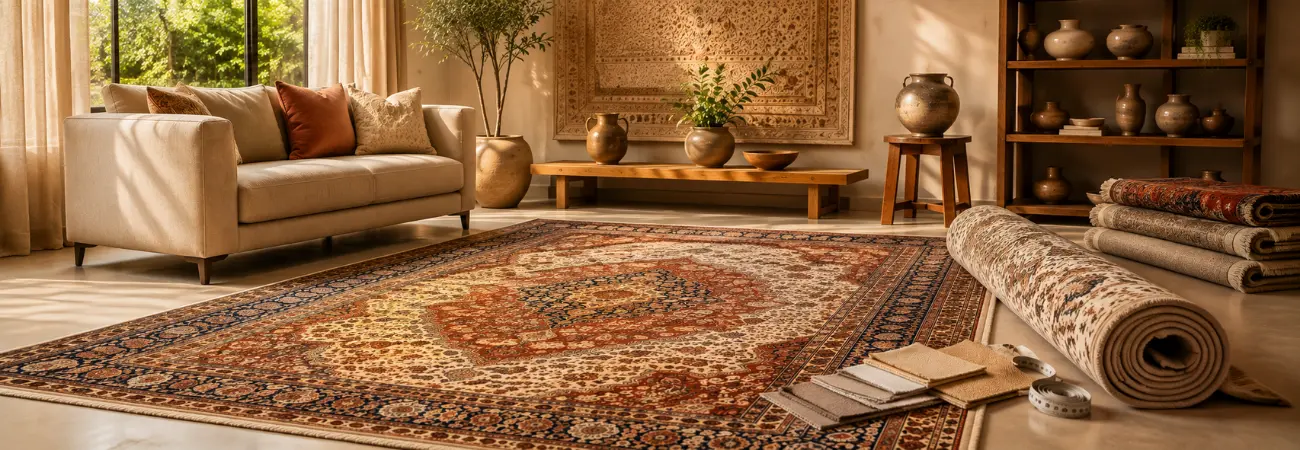
A handwoven rug can cost you a few thousand rupees or several lakhs, and that’s quite a spread. Lay two rugs side by side and they can appear nearly indistinguishable until you look at the craftsmanship, materials and construction. That’s usually when the handmade rug price disparity begins to make sense. Or doesn’t.
You don’t need years in the trade to figure out how to buy a handmade rug. There’s a short list of things that decide what a rug is actually worth, and once you know them, most of the guesswork disappears, whether you’re furnishing a formal sitting room or need something tough enough for kids and a dog.
Here’s what to check before you pay, what to ask the person selling it to you, and the spots where buyers usually lose money without realizing it. Including how to tell a real handmade rug from a good copy. “Rug” and “carpet” mean the same thing across most of India, so it doesn’t matter which word got you here. Whether you searched for how to buy a handmade rug or how to buy a handmade carpet, the checks below apply the same way.
Quick Checklist Before You Buy
This is the short version of how to buy a handmade rug without the guesswork. Run through it before anything else.
Confirm it’s actually handmade. Power-loomed and tufted pieces get passed off as handmade more often than people think. Check the material. Wool, silk, and blends age very differently. Look at the knotting on the back. One check, more useful than half this list combined. Ask where it was made. Origin shapes both the look and the price. Ask how it was dyed. Natural and synthetic dyes don’t age the same. Compare craftsmanship before price. A bigger number isn’t proof of anything. Watch how the seller answers. Hedging is an answer too.
Go through this before you commit to anything. Most regret-buying stories trace back to skipping one of these handmade rug buying tips.
Why Do Handmade Rugs Vary So Much in Price?
From the outside, rug pricing can seem almost random. It isn’t. Several factors work together to determine what a rug is worth.
- Craftsmanship: The skill and time involved in making the rug affect its price.
- Materials: Higher-quality or more expensive wool and other fibres increase the cost.
- Knot Density: More knots usually mean more detail, time, and labour.
- Design Complexity: Intricate patterns take longer and require greater skill to create.
- Size & Origin: The rug’s size and where it was woven also influence its final price.
Two rugs of the same size can therefore have very different prices. For more on this, see our piece on why handmade rugs cost what they do.
Things Worth Checking Before You Buy
You’re not required to be an expert to buy smart for a handmade rug. The bulk of what really counts boils down to a couple of checks you can do in a matter of minutes, in the showroom or from a handful of photos. Here’s what to examine before you sign on the dotted line.
Match Room Use
Begin with the end in mind where the rug is really going. An area for living and dining must withstand daily traffic and the occasional spill. A bedroom rug modestly faced each, so you can snuggle into softness and intricate patterns, rather than extremities of toughness. Get this backwards and you either end up with something too delicate for a busy room, or something overbuilt for one that barely gets used.
Pick By Lifestyle
Then pick material based on how the space is used, rather than how it appears. This is truly where to buy a handmade rug really begins, as material impacts more of the rug than most of buyers expect.
| Material | Best For |
| Wool | • High-traffic areas• Everyday durability |
| Silk | • Formal rooms• Low-traffic display pieces |
| Wool-Silk Blend | • A balance of resilience• A touch of shine |
Wool forgives a lot. Hides dirt reasonably well, bounces back after years underfoot. Silk’s a different animal entirely, beautiful under the right light and capable of much finer detail, but it wears down faster and mostly belongs somewhere nobody’s actually walking.
Check The Back
Flip the rug over before anything else. Small move, tells you more than most of what a seller will say to your face. A genuinely hand-knotted rug shows its pattern almost as clearly on the back as the front, with small, natural irregularities in the knotting that a machine just can’t fake. Machine-made pieces look too clean back there, almost printed rather than woven.
Inspect The Fringe
Check the fringe too, while you’re at it. On a real handmade rug it grows straight out of the rug’s own foundation threads. Glued or stitched on separately? That tells you what you need to know. This back-of-the-rug check is the fastest way to separate authentic handmade rugs from convincing copies. Our guide to spotting an authentic handmade carpet goes further into these tells if you want more.
Skip Knot Obsession
People treat knot count as if that settles the entire question, when it really doesn’t. Higher knot density is not inherently superior to fewer knots per square inch, because the quality of the material, how tightly it’s wound, and the finishing each have an equal say. Well made low knot rugs with good wool will often outlast highly knotted ones made with mediocre materials.
Confirm The Origin
The origin is a bigger issue that most buyers don’t really understand at first. Persian, Kashmiri, Indian, and Afghan rugs are all born out of their unique weaving traditions, and that history is visible not only in the look, but also the price. The name “Kashmiri silk carpet” is a synonym of intricate fine detail work. A hand-knotted Persian rug has centuries of regional work and a denser wool pile. Tribal rugs, wool rugs, flat-woven kilims, all of them worth knowing, each in a different construction and price bracket. Can’t tell you where the rug came from? Time to pause there.
Know Your Price
What’s actually behind the number on the tag: materials, the hours and skill that went into weaving it, how complex the design is, the rug’s age and condition, whether the dye is natural or synthetic. Not the brand stitched onto a tag. Hand-spun wool dyed naturally usually costs more than the synthetic equivalent, even though from a few feet away you’d struggle to tell them apart. Handmade rug value comes down to these details, not the number printed on the tag.
View In Daylight
Showroom lighting makes everything look good, so don’t buy that line. Ask to see the item by a window, or if you’re shopping online, ask for photos taken with natural light. Daylight is, really, the only way to get a fair look at true color, catch the glint of good wool and silk, and spot the misdirections that indoor lighting rolls up.
Ask Direct Questions
A quality rug dealer should sell you on the rug, not just the price. Where it came from, what it’s made with, how it was constructed, how to care for it. Watch to see if they answer fluidly or if they qualify their answers with some vague reference to “quality workmanship.” They don’t know, or we’re not supposed to know the history of the rug.
Think Long-Term
Think beyond the price tag when you’re shopping. A classic rug is designed not to date, so ask how long it will last, and if it can be fixed in that time. You can usually repair good quality, traditionally made rugs rather than dump them, which quietly changes what you really pay for over the years you own it.
Where Buyers Usually Lose Money?
Buying a hand-made rug is an investment for the long term, so there are a few mistakes common among buyers that are worth avoiding.
- Judging by looks alone: A rug can be gorgeous beneath the bright lights of a showroom, but it might not wear well.
- Overlooking the material check: Wool, silk and mixtures mature at different rates, so always verify the fibre.
- Getting the size wrong: A rug in the wrong size may not work well in a room and could end up being replaced.
- Don’t rely so heavily on knot count: There isn’t a direct correlation between more knots and better quality or workmanship.
- Concentrating on the price alone: The cheapest or the most expensive rug is not always the best pick. Evaluate its quality, manufacture and value.
Questions Worth Asking the Seller
The seller can tell you a lot about the quality, history, and care needs of a rug.
- Is it really hand-knotted? Find out how the rug was constructed and look at the back for evidence of being handmade.
- What is it made from? Does it contain wool, silk, or some combination thereof?
- Where was it made? The origin can tell you a bit about workmanship.
- Are the dyes natural or artificial? This can have an effect on the look of the rug, as well as how to clean it and how much it’s worth.
- How do I care for it? Ask about any previous restorations and approximately how long it took to weave.
Final Thoughts
Good-value buying is not about locating the lowest figure on the showroom floor. It’s just knowing what you are buying, so the price isn’t a mystery. When you learn to tell the difference between the genuine product and the fake, purchasing a handwoven carpet stops being intimidating and approaches easy. keep this hand-knotted rug buying guide handy while comparing pieces and the choice will be a lot less stressful.
For particular types, we have discussed Kashmiri silk carpets, Persian rugs, tribal rugs, kilim rugs, and wool rugs in detail. When you’re ready to buy, our advice on how to buy the perfect Kashmiri carpet, sourcing a carpet supplier in India, and shopping for carpets in India provide more information.
But here’s the thing a lot people could use to remember: ‘rug’ and ‘carpet’ are interchangeable in most of India, so none of this applies to the word that brought you here. Origin, material, knot consistency, and a seller who answers your questions. That is what you want, no matter what term you searched for, and that is the answer whether you searched how to buy a handmade rug or how to buy a handmade carpet.
Choose the rug first. Keep everything around it simple. Let the work of the artisan be what it is meant to be. That’s how to style a Persian rug in a modern home, and in 2026, as rug trends 2026 continue confirming, it’s one of the best design decisions you can make.
At Jansons Carpets we have made it simple to bring real craftsmanship into a contemporary space.As one of the best carpet supplier in Delhi and carpets exporter in India, we have a well-curated range spanning every category:
- Persian Rugs
- Kashmiri Rugs
- Afghan Rugs
- Woolen Rugs
- Wool Rugs
- Kilim Carpets
- Tribal Rugs
- Bold Geometric Rugs
- Handmade Runner Rugs
- Silk on Silk Carpets
- Vintage Inspired Rugs
- Handmade Indian Carpets
- Handmade Antique Carpets
We also provide expert carpet cleaning services and carpet restoration to ensure your carpet looks as good as new for years. If purchasing Kashmiri rugs for the first time, or in search of a wool carpet store with a wide variety of Indian carpets and rugs for commercial use, we are here to assist.
Call us at +91 98111 29095 to talk to an expert and choose the perfect item for your space.
FAQs
Q1 . How to avoid overpaying for a handmade rug?
Compare craftsmanship before you compare price tags. Two rugs priced very differently could both be fair, or both overpriced. The number alone won’t tell you which. Check knot density, wool or silk quality, dye type, and origin side by side, and the price starts to make sense on its own.
Q2 . What to look for when buying a handmade rug?
Flip it over first. A genuinely hand-knotted piece shows the pattern almost as clearly on the back as the front. From there: the material, the knotting, how the fringe’s attached, the dye, where it was made. None of that has much to do with a brand name or a nice showroom.
Q3 . How to identify a quality handmade rug?
Small, natural irregularities in the knotting, not machine-perfect uniformity. A back that mirrors the front. Fringe woven from the rug’s own foundation threads, not glued on. Those three together will rule out a power-loomed or tufted piece pretending to be handmade, and they’re the quickest test for handmade rug quality overall.
Q4 . How to check handmade rug quality before buying?
See it in daylight, not showroom lighting. That’s really the only honest way to judge color and catch the sheen that separates good material from mediocre. Run a hand over the pile for density, flip it to look at the knotting, ask the seller directly about origin and dye. How readily they answer tells you almost as much as the rug does.
Q5 . Are handmade rugs worth it?
Yes, in general, as long as they are really handmade and taken care of somewhat. They retain value better than their machine-made counterparts, age better and can often be repaired rather than replaced. That’s most of the reason why a hand-knotted wool or silk rug feels like a purchase for the long term instead of a disposable one.
Q6 . What are the signs of a good handmade rug?
Consistent knotting. A back that mirrors the front. Natural dyes with slight, honest variation instead of a flat uniform color. A seller who talks about origin and construction without reciting a script is another good sign. Knot count alone won’t tell you any of this.