

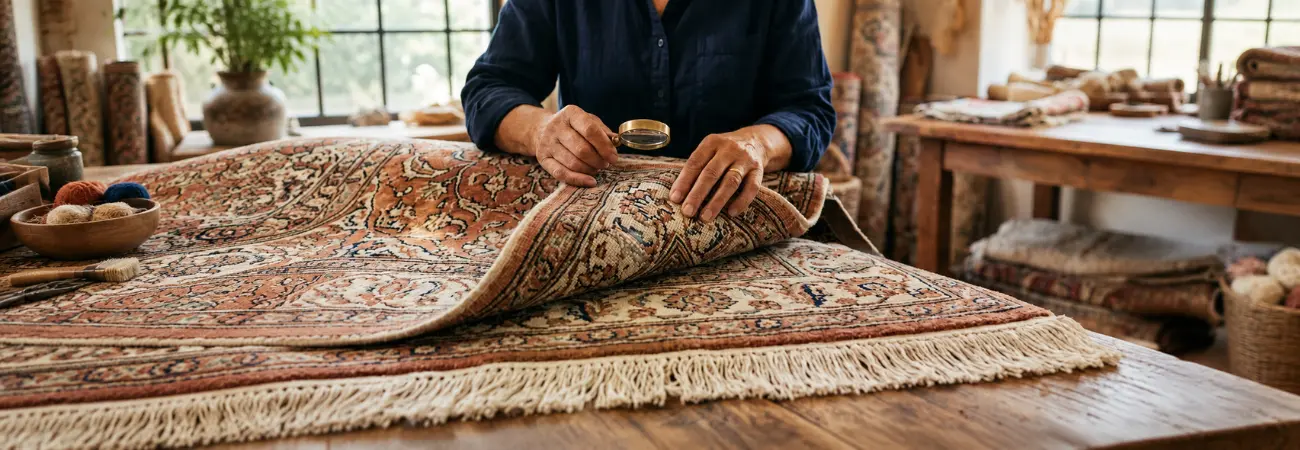
You’ve found a rug you like. It’s handmade, the price feels reasonable and it looks good on the showroom floor. But how do you actually know if it’s good quality, or if you’re paying for a name and a nice photo?
Buyers walk into this decision focused on the wrong things half the time — price, material, knot count — and end up surprised later when a “premium” rug doesn’t hold up the way they expected. Appearance alone won’t tell you what you need to know, and if you’ve ever wondered how to tell if a rug is good quality just by looking at it, the honest answer is: you can’t, not fully. You have to check it, piece by piece.
So how can you tell if a handmade rug is high quality? You look at the whole thing. Fiber, knotting, construction, design precision, dyes, pile, finishing, condition, craftsmanship — all of it together. A high knot count or a fancy material tag doesn’t automatically make a rug better, and we’ve seen plenty of expensive rugs that fall apart on close inspection once you know what to check.
This guide is essentially a full handmade rug buying guide built around one question: how to identify a quality handmade rug before you spend the money on it. We’ll walk through 10 practical checks — how to tell if a handmade rug is high quality in a way you can actually apply in a showroom, not just in theory — so you can compare rugs confidently and understand what you’re really paying for.
What Makes a Handmade Rug High Quality?
A high-quality handmade rug is generally distinguished by the quality of its materials, construction, craftsmanship, design execution, finishing and condition. No single factor determines handmade rug quality on its own — not knot density, not price, not even material. Here is a quick guide for identifying a Quality Handmade Rug.
| What to Check | What to Look For |
| Fiber | Good-quality wool, silk, or a suitable blend |
| Knotting | Secure and consistent construction |
| Knot Density | Appropriate for the design and construction |
| Design | Clear motifs and well-executed details |
| Dyes | Good color depth and appropriate colorfastness |
| Pile | Even and appropriate for the rug’s intended use |
| Finishing | Neat edges and secure ends |
| Back | Consistent construction and workmanship |
| Condition | Minimal damage or clearly disclosed repairs |
| Provenance | Reliable information about origin and craftsmanship |
That table is basically how to evaluate a handmade rug in one glance. Everything below just unpacks it.
10 Things to Check When Buying a Handmade Rug
If you take nothing else from this guide, take this section — it’s the practical core of how to identify a quality handmade rug, the part you can actually carry with you into a store or a virtual showroom. Each of these ten checks covers a different part of the rug, and none of them works well as a stand-alone test. Together, they answer what to look for when buying a handmade rug far more reliably than any single spec sheet or seller’s pitch ever will. Think of this less as a checklist to rush through and more as a habit — the same ten things you’d instinctively check once you’ve bought a few rugs and learned, sometimes the hard way, which details actually matter. Here are the Tips on how to identify a Quality Handmade Rug you should look at:
1. Check the Quality of the Fiber
Press your thumb into the wool. Good wool pushes back; tired, low-grade wool just stays flat. That single test tells you more than most product descriptions ever will. Silk should feel fine and cool to the touch, with a natural sheen — not the slightly plasticky shine you get from synthetic viscose trying to pass itself off as silk, which happens more often than buyers realize. Wool-silk blends should feel genuinely balanced, not like a cheap wool base with a bit of gloss thrown over it to justify a higher price.
Don’t assume silk automatically beats wool. A busy hallway is usually better served by a dense, well-made wool rug than a delicate silk one that’ll show wear within a year.
2. Examine the Knotting and Construction
This is probably the single most reliable way to judge quality, because it’s where the weaver’s actual skill shows up, not just their materials budget.
Flex the rug slightly and feel whether the construction holds together or shifts loosely. Look at knot consistency across the piece. Handmade rugs will always show some variation — that’s not a defect, that’s the human hand at work — but there’s a difference between charming irregularity and sloppy, inconsistent weaving. You’ll know it when you feel it.
For a closer look at how this construction comes together in the first place, our guide on how hand-knotted rugs are made walks through the whole process.
3. Look at Knot Density — But Don’t Judge the Rug by It Alone
Knot density gets treated like a magic quality score, and honestly, that’s a mistake sellers are sometimes happy to let buyers make.
| Factor | What It Can Tell You |
| Higher Knot Density | Potential for finer detail and more intricate patterns |
| Lower Knot Density | May suit simpler designs or certain rug constructions |
| Overall Quality | Depends on more than knot count, including materials, craftsmanship and finishing |
Higher density can carry finer pattern detail and usually means more labor went in. Fine. But a lower-density rug built around a bold, simple tribal rugs design can be every bit as well made as a dense, intricate Persian rugs piece — they’re just doing different jobs. Our article on knot density in rugs gets into how to actually read this number instead of treating it like a shortcut to quality.
4. Inspect the Design and Pattern Precision
Look at pattern clarity, motif definition, borders, symmetry, proportion. Does the design feel intentional, or does it wander?
Small variations — a border that’s slightly off in one corner, a motif that shifts a touch as it repeats — are often signs of genuine handwork, not flaws. What you’re watching for is the difference between that kind of human variation and actual distortion: a pattern that clearly loses its shape, or motifs that look rushed and uneven in a way that has nothing to do with tradition and everything to do with a weaver cutting corners.
5. Examine the Colors and Dyes
Check color depth, whether shades stay consistent across sections that should match, and any sign of bleeding where colors meet. If the rug isn’t new, look at how the dye has aged — fading should happen evenly across the piece, not in odd patches that suggest uneven sun exposure or a dye that was never properly set.
Does natural dye automatically mean a better rug? People ask us this constantly, and the honest answer is no — it’s one factor, not a verdict. A well-applied synthetic dye will outlast a badly applied natural one every time. Our guide on natural dyes vs synthetic dyes in handmade rugs goes into exactly how each behaves and what’s worth asking a seller.
6. Feel and Examine the Pile
Run your hand across it. Check evenness, texture, density, and look for spots of excessive wear if you’re buying a vintage or previously-owned piece. A low, tight pile handles heavy traffic far better than a tall, plush one — worth thinking about before you fall for a rug that just feels luxurious in the store.
One thing we’d stress: inspect this in person and under good light. Photographs flatten texture completely, and pile is one of those things you genuinely cannot judge from a screen.
7. Check the Edges, Ends, and Finishing
This is the detail most first-time buyers skip entirely, and it’s often where you can spot corner-cutting fastest. Look at the side edges (overcasting), the fringe, the ends, the binding. Any loose threads?
Neat finishing isn’t decoration — it’s structural. A fringe that’s already fraying at purchase, or edges that feel loose rather than tightly bound, will only get worse with use, and eventually that affects the whole rug, not just the border.
8. Turn the Rug Over and Inspect the Back
The back tells you things the front hides — knot structure, how consistent the construction really is, how sharply the pattern comes through on the reverse, and whether there’s been any repair work.
Just don’t treat it as some single make-or-break authenticity test, which is a mistake we see buyers make constantly after reading one blog post that told them to “always check the back.” It’s one useful clue among several. For the fuller picture, see our guide on how to identify an authentic handmade carpet.
9. Check the Rug’s Condition and Any Repairs
Especially important with older or higher-value pieces. Look for worn patches, thinning pile, holes, reweaving, staining, any color restoration, prior repairs, uneven wear.
Here’s the distinction that trips people up: a beautifully constructed rug can still have real condition issues, particularly if it’s vintage. That doesn’t make it a bad rug — it makes it a rug you need to price accordingly. Craftsmanship and condition are two separate questions, and conflating them is how buyers either overpay or walk away from something genuinely good.
10. Ask About Origin, Craftsmanship, and Provenance
Don’t rely on looks and price tags. Ask directly:
- Where was the rug made?
- What materials were used?
- How was it constructed?
- What weaving tradition does it follow?
- Who made it, or where was it produced?
- Is there documentation on its origin?
- Are any repairs or alterations disclosed?
A seller who hesitates on these questions is telling you something. When buying from an established specialist such as Jansons Carpets, you should feel comfortable pushing on all of this rather than taking the price tag at face value. If you’re specifically weighing a Kashmiri piece, our guide to buying the perfect Kashmiri carpet covers a few extra questions worth asking.
Does an Expensive Handmade Rug Mean It’s High Quality?
Not necessarily, and this trips up more buyers than you’d think.
| Price Can Reflect | But Buyers Should Also Assess |
| Materials | Fiber quality and suitability |
| Construction | Weaving or knotting technique |
| Labor | Time and skill involved |
| Craftsmanship | Precision and overall workmanship |
| Knot Density | Detail and construction quality |
| Condition | Wear, damage and repairs |
| Design Complexity | Intricacy and level of detail |
| Finishing | Edges, ends and overall finish |
| Size | Dimensions and space requirements |
| Provenance | Origin and documented craftsmanship |
Sometimes a high price is entirely earned. Sometimes it’s mostly size, or a rare material, or brand markup that has nothing to do with how carefully the rug was actually made. Learning to separate the two is really the whole point of how to tell if a handmade rug is high quality in the first place. Our piece on why handmade rugs are so expensive breaks down what you’re genuinely paying for versus what’s just markup.
How to Compare the Quality of Two Handmade Rugs?
Don’t just ask which one’s cheaper. Ask what you’re getting for the difference.
Line them up against:
- Material
- Construction
- Knotting
- Design and detail
- Dye quality
- Pile
- Finishing
- Condition
- Provenance
- Intended use
Two rugs priced within a few thousand rupees of each other can be worlds apart once you actually compare them this way — one earning its price through fine wool and tight knotting, the other mostly just being bigger. Our smart buyer’s guide on how to buy a handmade rug without overpaying goes further into this.
Common Mistakes to Avoid When Judging Handmade Rug Quality
Even buyers who genuinely know what makes a handmade rug high quality in theory still trip over the same handful of mistakes in practice — usually because one feature looks impressive enough to distract from everything else. Knowing how to choose a high quality handmade rug is as much about avoiding these traps as it is about running through the checklist above. Here’s what to watch for:
- Assuming higher knot density always means better quality
- Assuming silk is automatically superior to wool
- Judging only by price
- Looking only at the front of the rug
- Ignoring condition and repairs
- Buying based only on photographs
- Comparing rugs without considering construction and craftsmanship
- Focusing on one feature instead of evaluating the whole rug
Nearly every case of buyer’s remorse we’ve come across traces back to one of these — someone anchored on a single number or feature and skipped the rest.
Handmade Rug Quality Checklist Before You Buy
Before purchasing, check:
- Fiber and material
- Knotting and construction
- Knot density
- Pattern and design precision
- Dyes and color
- Pile and texture
- Edges and finishing
- Back of the rug
- Condition and repairs
- Origin and provenance
- Price relative to overall quality
Don’t let one feature make the decision for you. Evaluate the whole rug, and don’t be shy about asking how it was made, what it’s made of, and how it’s been cared for.
Conclusion
No single feature makes a handmade rug high quality by itself. What actually matters is materials, craftsmanship, construction, design, dyes, finishing, condition, and provenance — all together, with each one playing a part, not a single deciding factor. For homeowners looking for handmade rugs that earn their place over time, Jansons Carpets brings deep expertise as a carpet supplier in India and a source for handmade carpets in India, offering custom pieces, professional restoration, and hands-on guidance across:
- Kashmir Silk carpets
- Persian Rugs
- Hand Knotted Rugs
- Afghan Rugs
- Kilim Carpet
- Wool rugs
- Tribal rugs
- Runner Carpets
- Geometric Rugs
- Antique Carpets
- Indian Carpets
- Vintage Inspired Rugs
Visit jansonscarpets.com, call us at +91-9811129095, or stop by our store in Delhi.
FAQs
Q1 . How can you tell if a handmade rug is good quality?
You check the whole rug, not one feature. Fiber, knotting, knot density, design precision, dyes, pile, finishing, the back of the rug, overall condition — quality shows up across all of it, and skipping any one of these is how buyers get surprised later. This is really the short version of how to identify a quality handmade rug.
Q2 . Does a higher knot count mean a better handmade rug?
It reflects labor and can support finer detail, but that’s about it. Plenty of lower-density rugs are exceptionally well made — knot count tells you about complexity, not quality.
Q3 . What should I look for when buying a high-quality handmade rug?
Materials, construction and knotting, design execution, dye quality, pile, finishing, condition, and provenance. Any one of these on its own is a weak signal; together they’re a real picture, and together they’re also the clearest signs of a high quality rug you’ll find without a lab test.
Q4 . Is a silk rug always better quality than a wool rug?
No, and this is one of the more persistent myths in rug shopping. A well-made wool rug will beat a poorly made silk one every time. Which material is “right” usually comes down to how and where you’ll use the rug.
Q5 . How can I tell if a handmade rug has good craftsmanship?
Look at construction and knotting consistency, how well the design was actually executed, the quality of the finishing, and the overall workmanship on both front and back. Craftsmanship tends to show up everywhere at once, not in one spot.
Q6 . Can an expensive handmade rug still be poor quality?
Yes — more often than buyers assume. Price can be driven by size or rare materials just as easily as genuine craftsmanship, so it’s worth checking construction and condition independently rather than trusting the number on the tag.