

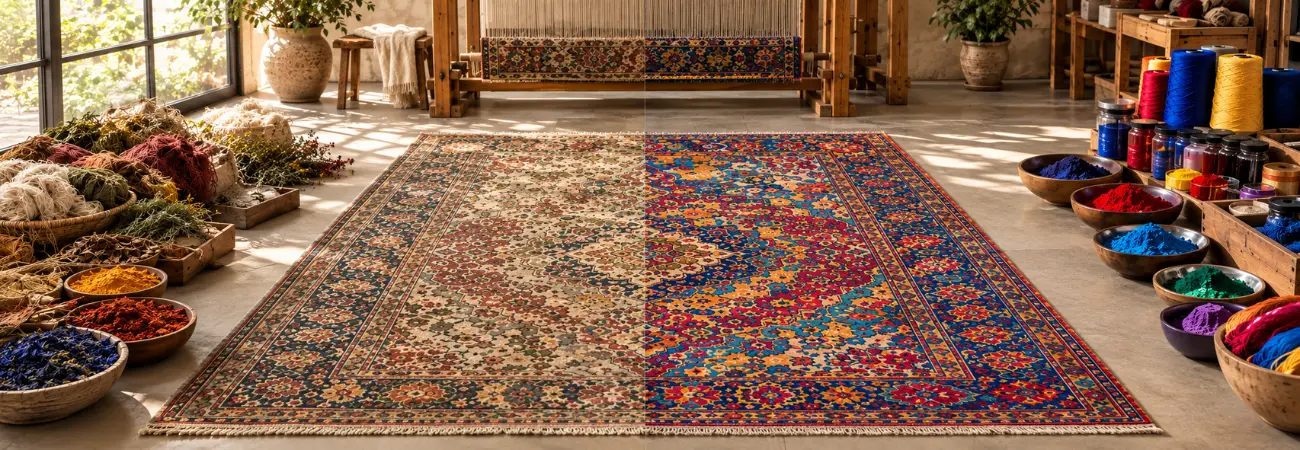
You’re rug shopping and you keep seeing the same four words: natural dyes, vegetable dyes, synthetic dyes. What do they mean, and is it really worth paying a premium for a rug because it’s naturally dyed? The question of natural dyes vs synthetic dyes in handmade rugs comes up in almost every buying conversation, and there’s no clean answer to it.
Dye changes colour and sometimes how a rug ages, but it’s not the whole story of quality — not even close. Materials, craftsmanship, construction, and finishing carry just as much weight, sometimes more, than which type of dye a weaver reached for.
This guide gets into what separates a natural dye rug from a synthetic dye rug, what each one actually changes about a handmade piece, and what’s worth weighing before you pay extra for either — because a natural dye vs synthetic dye rug decision shouldn’t be made on dye alone.
Quick Answer: Natural Dyes vs Synthetic Dyes in Handmade Rugs
The difference between natural dyes vs synthetic dyes in handmade rugs comes down to source and consistency. Natural dyes come from plants, minerals, and other organic sources, and they tend to produce colour that’s a little uneven and subtle. Synthetic dyes are manufactured, so you get consistency and a much wider colour range instead. Natural dyeing takes more labour, which can push the price up, but neither one alone tells you whether a rug is well made.
| Factor | Natural Dyes | Synthetic Dyes |
| Source | Plants, minerals and other natural materials | Manufactured chemical compounds |
| Colour Character | Nuanced, organic and naturally varied | Consistent and uniform |
| Colour Range | Traditionally narrower and more earthy | Very broad, including highly saturated shades |
| Production | Labour-intensive and hands-on | Easier to standardise and reproduce |
| Price | May add cost due to materials and labour | Not necessarily cheaper; overall rug value depends on other factors |
What Natural Dyes in Handmade Rugs Actually Are?
Madder root gives reds. Indigo gives blues. Walnut husks give browns. That’s the basic idea behind natural dyes in handmade rugs, plus certain minerals and other traditional materials thrown in. Most artisans prepare these themselves — soaking, boiling, or fermenting the source material, adjusting things until the shade looks right. The result is what buyers often call natural dye rugs or, more traditionally, vegetable dyed rugs.
Why Vegetable Dye Shows Up in Traditional Rugs?
Simple reason, really: vegetable dye is what weavers had before synthetic options existed. Persian, Kashmiri, and Indian weavers all built traditions around whatever grew locally, long before chemical dye came along. Dyes used in Persian rugs are a common example of how deep this history runs.
Dyes used in Kashmiri carpets carry a similar story, plant-based methods passed from weaver to weaver for generations. That’s a big part of why natural dyed carpets still read as more “authentic” to buyers today. Looking specifically at Kashmiri Silk carpets? Our guide on buying the perfect Kashmiri carpet covers what else matters beyond the dye itself.
What Synthetic Dyes in Handmade Rugs Actually Are?
Lab-made colourants, built for control and a bigger palette than nature alone offers. They took off because they’re consistent batch to batch and reach shades that are hard, sometimes impossible, to get naturally. Synthetic dyed carpets are extremely common today, even among high-end handmade pieces.
Worth saying clearly: synthetic dyes in handmade rugs don’t mean lower quality. Plenty of rugs are fully hand-knotted, made from excellent wool or silk, finished with real skill, and simply happen to use synthetic dye. Dye is one ingredient, not a verdict on the whole rug.
Natural Dyes vs Synthetic Dyes in Handmade Rugs: What Actually Differs Between Them?
When you line up natural vs synthetic dyes in rugs side by side, a few real differences stand out.
| Factor | Natural Dye | Synthetic Dye |
| Colour variation | • Natural shifts between batches create subtle variations• Often gives rugs a more handmade, organic appearance | • Produces more consistent, even colour• Offers greater uniformity across batches |
| Aging | • May develop added depth and softness with light and use• The ageing effect can contribute to character | • Ageing varies depending on the specific dye and fibre• No single ageing pattern applies to all synthetic dyes |
| Colour range | • Generally stays within an earthier, more limited palette• Colours depend on available plants and minerals | • Offers a broader range of shades• Better suited to saturated, unusual or highly specific colours |
| Dyeing process | • Involves sourcing materials, extracting colour and testing shades• Typically slower and more hands-on | • More standardised and repeatable process• Easier to achieve consistent results |
| Cost | • Often involves higher labour and material costs• Can contribute to a higher rug price | • Can be more cost-efficient in production• Price still depends heavily on the rug’s other qualities |
| Overall value | • Can add character and appeal, particularly for buyers who value traditional craftsmanship | • Provides consistency, colour flexibility and predictable results• Does not necessarily mean lower overall rug value |
| What really determines price | • Dye is only one part of the equation | • Knot density, size, material, design, condition and weaving skill can matter just as much or more |
Are Natural Dyes Better for Rugs?
No, not on their own. Easy assumption to make, but dye is just one piece of how dyes affect rug quality. Worth checking instead:
- Fibre quality — the grade of wool or silk
- Knotting and construction — how tight, how even
- Craftsmanship — skill visible across the weave
- Design — how well the pattern comes together
- Dye application — how well the colour was set, whichever type
- Finishing — edges, fringe, the back of the piece
- Condition — especially for older or vintage rugs
- Provenance — where it came from, what’s documented
A synthetically dyed rug with tight knotting and fine wool beats a naturally dyed rug that’s loosely knotted or poorly finished, easily. Dye sets a tone — that’s about it. This is exactly why the natural vs synthetic dyes in rugs question needs to be paired with a look at construction, not answered in isolation.
Do Natural Dyes Fade? Do Synthetic Dyes Fade?
Yes, natural dye fades over time. Sunlight is the biggest factor, plus the specific dye, the fibre, and the rug’s age. Keep it out of harsh sun and it holds colour far better than a piece left in a bright room for years.
Do synthetic dyes fade too? They can, though it depends heavily on the quality of the dye and how well it was fixed. Bleeding comes down to how well the dye was set in the first place, not really whether it’s natural or synthetic. A properly dyed rug should hold up fine either way. Moisture is worth being careful with, especially wet cleaning, unless you know for sure the dye is colourfast. Synthetic isn’t some guarantee against bleeding either — badly applied synthetic runs just as easily as badly applied natural dye.
Whatever dye your handmade rug has, good carpet care matters a lot over time.
Are Natural Dyed Rugs Worth It? Are Natural Dye Rugs More Expensive?
Usually, yes, natural dye adds to the price. Sourcing the material, preparing it, applying it — all of that takes more time and skill than reaching for pre-mixed synthetic dye. That labour ends up in the price, and slower, more traditional methods add to it too.
But natural dye by itself doesn’t justify a higher price tag. It’s one factor among several, and craftsmanship matters just as much, arguably more. So are natural dyed rugs worth it? Only when the rest of the rug — materials, knotting, finishing — backs up the price alongside the dye.
How to Tell If a Rug Uses Natural Dyes?
There’s no foolproof way to identify natural dyes in rugs, but a few things help:
- Ask the seller directly
- Look into origin and provenance
- Check for dyeing documentation, if it exists
- See whether the dyeing fits the rug’s age and style
- Get a professional opinion for valuable or antique pieces
Appearance alone won’t settle it. Subtle variation can hint at natural dye, but good synthetic work mimics that look convincingly. Ask questions, look for paperwork, don’t just trust your eye.
The same idea applies to authenticity more broadly — dye, construction, and origin all need to be checked together, not one at a time, when you’re trying to confirm what you’re buying.
| Factor | Why It Matters |
| Material | • Determines feel and durability• Influences appearance and longevity |
| Knot density | • Reflects construction quality• Supports finer patterns and details |
| Craftsmanship | • Shows the skill and precision of the handwork• Can significantly influence value |
| Design | • Adds visual appeal• Pattern complexity and originality can increase desirability |
| Condition | • Important for preserving appearance and usability• Particularly significant for vintage and antique pieces |
| Provenance | • Provides context and supports authenticity• A documented history can add to a rug’s value |
Knot density especially outweighs dye type on its own when it comes to how dyes affect rug value in the resale or appraisal sense — a well-knotted, well-finished rug will hold value regardless of which dye family it used.
So, Which Dye Is Better for Handmade Rugs?
There’s no clean answer, honestly. It comes down to what you personally value.
Like traditional craftsmanship, that natural unevenness, watching colour deepen with age? Natural dye. Want a bigger colour range, more consistency, or a specific modern shade nature can’t produce? Synthetic makes more sense. If you’re weighing Tribal rugs, Wool rugs, or a Kilim Carpet, the same logic applies — check the dye, then check everything else.
What matters most is the rug in front of you, not the label.
- Natural Dyed Rug Buying Guide: Questions to Ask Before You Buy
- Natural or synthetic dye?
- What specific dye?
- Any information on the rug’s origin?
- How should it be protected from sun and moisture?
- What else, besides dye, explains the price?
- Can the seller speak to materials and construction?
This works whether you’re buying a small accent piece or an investment carpet. At a specialist like Jansons Carpets, you should feel comfortable asking exactly these questions and getting a straight answer.
Bottom Line: Natural Dyes vs Synthetic Dyes in Handmade Rugs
Neither dye makes a rug better by itself. What actually matters is materials, craftsmanship, construction, design, condition, and provenance — all together, with dye as one part of that, not the deciding factor. For homeowners looking for pieces that earn their place over time, Jansons Carpets brings deep expertise as a carpet supplier in India and a source for handmade carpets in India, offering custom pieces, professional restoration, and hands-on guidance across:
- Kashmir Silk carpets
- Persian Rugs
- Hand Knotted Rugs
- Afghan Rugs
- Kilim Carpet
- Wool rugs
- Tribal rugs
- Runner Carpets
- Geometric Rugs
- Antique Carpets
- Indian Carpets
- Vintage Inspired Rugs
Visit jansonscarpets.com, call us at +91-9811129095, or stop by our store in Delhi.
FAQs
Q1 . Does natural dye cost more?
Usually, yes, mainly because sourcing and preparing natural dye takes more time and skill than working with synthetic dye. That labour gets built into the price, along with slower, more traditional dyeing methods. That said, knot density, materials, size, and craftsmanship all shape the final price too, so natural dye is rarely the only factor driving cost up — which is really the whole point of understanding natural dyes vs synthetic dyes in handmade rugs before you buy.
Q2 . Should I pay extra for natural dye?
Not on the strength of the dye alone. Natural dye can be part of what justifies a higher price given the labour involved, but it shouldn’t be the deciding factor by itself. Look at the whole rug — materials, construction, craftsmanship, and condition — before deciding whether the asking price makes sense.