

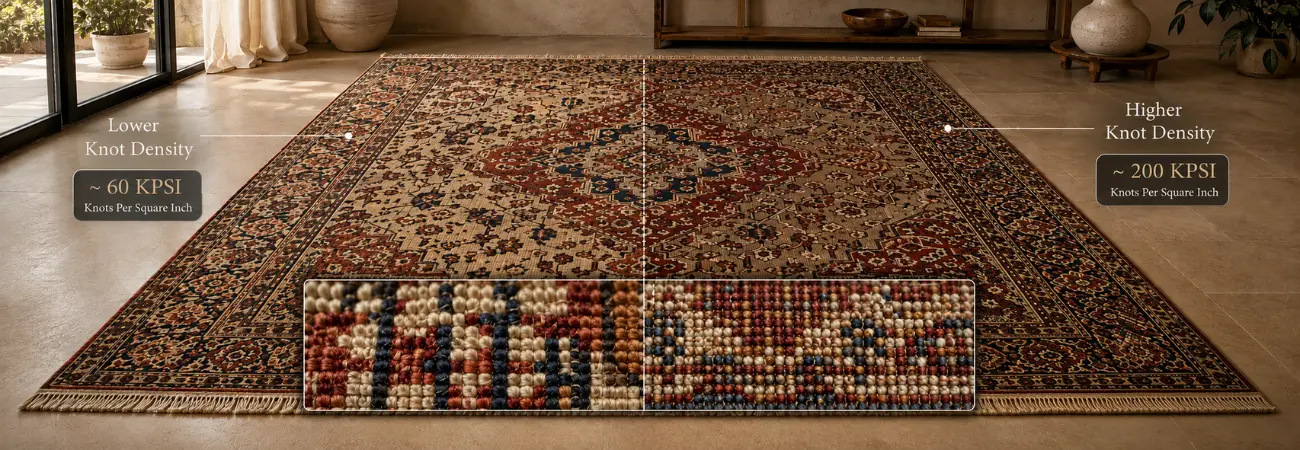
Have you ever looked at two hand-knotted rugs and wondered why one is so much more expensive than the other? That’s the cost-density ratio. But what exactly is knot density — and does more knots always mean a better rug?
How many times has the term knot density come up in your research? It can affect how detailed a rug can be, how long and how skilled you need to be in order to make it, and in some cases — how much money you’re going to pay for it. But a high knot count alone does not tell the full story.
Knot density is a term related to the number of knots in the weave density per unit area of a carpet. It can affect how detailed a carpet can be, how long and how skilled a worker needs to be to make a carpet, and how much money you are going to pay for it. But knot density, it turns out, is just one factor to consider.
A quality good rug raw material and its skillful working should be assessed in combination with design, quality of weave, colors and dyeing processes, finishing and way of use for extent and ruggedness.
This guide will explain what knot density in rugs means, how it’s calculated, the impact it may have on quality and cost, and the things to be aware of before you decide to buy according to a knots per square inch rug number instead of the eye test on a handmade rug.
Quick Answer: What Is Knot Density in a Rug?
So, what is knot density, anyway?
The amount of knots in a certain area of a hand-knotted rug Knot density represents how many individual knots a rug has, in a particular area, generally in a square inch or square meter in hand-knotted rugs. It reflects how tightly a rug is knotted and it can affect the amount of design detail, the time required to weave a rug and the expertise needed to create it.
Yet overall higher quality does not necessarily follow from higher knot densities. When it comes to reading knot density in rugs, the fabric, knot quality, design, dyes, construction and finishing are just as important also.
Quick-Reference Table
What can knot density actually tell you, and what does it leave out?
| Factor | What Knot Density Can Tell You | What It Cannot Tell You Alone |
| Detail | Higher density can support finer pattern detail | Whether the design is aesthetically better |
| Craftsmanship | Indicates a more time-intensive construction in many rugs | Overall artisan skill |
| Production time | More knots generally require more knotting work | Exact weaving time |
| Price | Can contribute to higher prices | Whether the rug is fairly priced |
| Quality | One useful construction indicator | Overall rug quality |
How Is Knot Density Measured in a Rug?
How do the experts come up with a knot-density number?
If you’d like to know how to measure rug knot density, know that rug knot count is nothing complicated. At its most basic, it’s a question of how to count How tightly the knots are clustered in a particular section of the weave.
Knots Per Square Inch (KPSI)
What is KPSI and how is it calculated?
Knots per square inch is one of the most popular measurements used especially in the West and for Persian and oriental rug dealers. Generally, to determine the density, an expert will count the number of knots in a horizontal inch and a vertical inch on the back of the rug, and then multiply the two numbers. A rug with 100 knots per square inch, for example, has a lot more knotting in it than one with 40.
Knots Per Square Meter
Is KPSI universally accepted?
Not exactly. In some other rug-making corners, the rug knots per square inch is not the regular unit — instead, they use knots in a square meter or even in a square decimeter, again, according to local habit. Because the units used in different markets are inconsistent, the figures shown to buyers are often not a true like-for-like comparison.
Why Measurements Need Context?
Can you take a knot-density figure at face value?
Not always. Knot-density figures should be compared carefully, because weaving traditions, construction methods, and measurement practices can differ significantly from one rug-producing region to another. A number quoted for a Persian rug isn’t necessarily calculated the same way as one quoted for a Tibetan or Turkish piece. Before treating a KPSI figure as a meaningful comparison point, it helps to understand how — and by whom — it was measured.
Suggested visual: a close-up photograph of the back of a hand-knotted rug, with a small area marked off to illustrate how knots are counted.
Does Higher Knot Density Mean a Better Rug?
This is one of the most important questions buyers ask, and it deserves a direct answer.
Not necessarily. Higher knot density can allow for greater pattern detail and usually involves more knotting work, but it does not automatically make a rug superior in every respect.
So, is higher knot density better? Only in certain contexts — and only when considered alongside everything else that goes into the rug. Understanding how knot density affects rug quality means weighing it against a number of other factors, not treating it as a standalone score.
Other factors that matter just as much, if not more, include:
- Fiber quality — The grade of wool or silk used affects durability, sheen, and how the rug feels underfoot, regardless of how many knots were tied.
- Knot consistency — Even, uniform knotting produces a flatter, more even pile than inconsistent knotting, even at the same density.
- Construction — How the foundation, warp, and weft are put together affects the rug’s structural integrity and how well it lies flat.
- Dye quality — Colorfastness and depth of color depend on the dyeing process, not on how tightly the rug is knotted.
- Design — A well-composed, balanced design executed at a modest density can outshine a cluttered or poorly proportioned design executed at a high density.
- Finishing — Clean edges, secure fringe, and even trimming reflect the same level of care that goes into knotting, and affect how the rug wears over time.
- Condition — A rug’s current state (wear, repairs, fading) matters more to its real-world value than its original knot count.
- Origin and weaving tradition — Different regions have different conventions for density, materials, and motifs, so density figures mean different things in different traditions.
- Suitability for the intended use — A rug destined for a high-traffic hallway has different practical requirements than one intended as a decorative wall hanging or in a formal, low-traffic room
When Higher Knot Density Can Matter?
When does a higher knot count actually pay off? A high knot density rug tends to be worth seeking out when the design itself calls for it — for example:
- Intricate floral patterns — Closely packed knots allow petals, stems, and leaves to be rendered with soft, natural-looking curves rather than blocky outlines.
- Fine medallions — A central medallion with layered detailing needs enough knots to render its inner patterning without the design collapsing into a blur.
- Detailed borders — Multiple nested border bands with small repeating motifs require fine knotting to stay legible at a small scale.
- Complex pictorial designs — Scenes with figures, animals, or landscapes rely on higher density to convey shading, proportion, and perspective.
- Fine silk rugs — Silk’s thin, smooth fibers are typically knotted at high density to take advantage of the fiber’s ability to hold crisp, fine detail and sheen.
In these cases, more knots per square inch genuinely translate into crisper lines, smoother curves, and richer detail — because the design itself is ambitious enough to need that extra resolution.
When Lower Knot Density Can Still Produce an Excellent Rug
Does a lower knot count mean a lesser rug? Not necessarily. A low knot density rug isn’t automatically a lesser rug. Many of the most prized handmade pieces in the world are woven at a coarser density because the design doesn’t need — or even benefit from — extreme fineness:
- Bold geometric designs — Angular shapes, stripes, and repeating patterns read clearly even at a coarser density, since they don’t rely on fine curves or gradients
- Tribal rugs — These often draw their appeal from expressive, hand-drawn irregularity rather than mathematical precision, which a lower density doesn’t compromise
- Rustic or expressive patterns — A looser knot allows the wool’s natural texture and character to come through, which is often the point of the design
- Rugs where texture and character matter more than extremely fine detail — A thicker, more tactile pile can be a deliberate design choice rather than a shortcut, especially for casual or heavily lived-in spaces
This distinction is essential. It’s what separates a genuinely useful understanding of knot density in handmade rugs from an oversimplified “more knots equals better” rule of thumb.
How Knot Density Affects the Look and Detail of a Rug?
Why does knot density change how a rug looks? Knot density is closely tied to visual resolution — think of it as similar to the way pixel density affects the sharpness of a digital image.
Finer Patterns and Intricate Details
What kind of detail does extra density actually buy you? The more knots packed into a given space, the more precisely a weaver can render small design elements — delicate vines, tiny rosettes, fine calligraphy, or shaded gradients.
Definition in Curves, Borders and Motifs
Why do curves suffer most at lower densities? Curved lines and rounded motifs are especially dependent on density. At lower densities, curves can appear more angular or “stepped,” while higher densities allow for smoother, more naturalistic shapes in borders and medallions.
Why Design Style Matters
Does every design need the same density? Not at all. A bold geometric rug does not necessarily need the same knot density as a highly detailed floral or pictorial rug. This is exactly why the “right” density depends partly on the design being woven, not on some universal quality benchmark. A tribal rug knotted at a lower density, executed with skill and character, can be just as accomplished — in its own idiom — as a finely knotted silk piece.
How Knot Density Affects the Price of a Handmade Rug
Does knot density affect rug price? How much does it actually influence what you pay? This is where knot density and rug value connects most directly with a buyer’s purchasing decisions.
Higher knot density in rugs can require:
- More individual knots
- More labor
- Greater precision
- More weaving time
But price also depends heavily on:
- Material
- Size
- Design complexity
- Origin
- Dye quality
- Craftsmanship
- Age and condition
- Rarity
- Provenance, where relevant
Comparison Table
Where does knot density rank next to other price drivers? The table below breaks down how knot density stacks up against other cost drivers, so you can see where it fits into the bigger pricing picture.
| Factor | Potential Effect on Price |
| Higher knot density | May increase labor and production time |
| Premium silk or fine wool | Can increase material cost |
| Complex design | Requires greater precision and time |
| Larger size | Requires more material and labor |
| Skilled craftsmanship | Adds to the value of handwork |
| Natural or specialty dyes | May add to material and production cost |
| Age, rarity or provenance | Can affect value in appropriate markets |
Key takeaway: A higher knot count can help explain part of a rug’s price, but it should never be used as the sole justification for a premium price. If you’d like a deeper look at what actually drives handmade rug pricing, see our related guide, Why Are Handmade Rugs So Expensive? What You’re Really Paying For.
Knot Density in Persian, Kashmiri and Other Handmade Rugs
Does knot density mean the same thing across every rug tradition? Not quite. Handmade rug knot density varies considerably across weaving traditions, and comparing figures across categories without context can be misleading. This is one of the areas where knot density in rugs is most often misunderstood by first-time buyers.
- Persian Rugs — Knot density varies by region and workshop tradition
- Kashmiri Silk carpets — Often prized for fine detailing and craftsmanship
- Handmade carpets in India — Density varies widely by design and region
- Silk rugs — Frequently knotted at higher densities to support fine detail
- Wool rugs — Density varies based on intended durability and design
- Tribal rugs — Often knotted at lower densities, prioritizing character over fineness
Kilim Carpet weaves are a related but distinct flat-woven category, where the concept of knot density doesn’t apply in the same way since kilims are woven rather than knotted
Comparison Table
What else should you weigh alongside density for each rug type? Here’s a quick side-by-side of what to weigh alongside knot density for each major rug category.
| Rug Type | What to Consider Alongside Knot Density |
| Persian rugs | Weaving tradition, design, materials, and regional characteristics |
| Kashmiri carpets | Fiber, fine detailing, craftsmanship, and weaving tradition |
| Silk rugs | Fiber quality, fineness, sheen, and design detail |
| Wool rugs | Wool quality, construction, resilience, and intended use |
| Tribal rugs | Design character, wool quality, construction, and regional tradition |
It’s worth noting that there’s no single “ideal” KPSI figure that applies across all these categories — the appropriate density is tied to the specific weaving tradition and the design being executed. If you’re specifically shopping for fine Kashmiri pieces, our guide on Buying Perfect Kashmiri Carpets walks through what to look for beyond the knot count. And for a broader look at handmade rugs across traditions, see our full collection guide.
What Else Should You Look at When Judging a Handmade Rug?
What should you actually be examining besides the knot count? Understanding how to evaluate a handmade rug — and what makes a high quality handmade rug in the first place — means looking well beyond a single specification.
Material Quality
What does the fiber itself tell you? The fiber a rug is made from shapes how it feels, wears, and ages over time, so it’s worth examining closely before you focus on anything else.
- Wool quality
- Silk quality
- Fiber consistency
- Feel and resilience
- Knot Consistency and Construction
What does the construction beneath the surface reveal? Beyond the raw count, how evenly and securely a rug is knotted says a lot about the skill behind it.
- Consistency of knotting
- Back construction
- Overall structural integrity
- Design Precision
Does the design hold up under close inspection? A well-executed design should look intentional and controlled at every scale, not just from across the room.
- Clear motifs
- Well-defined borders
- Balanced composition
- Appropriate pattern detail
- Dyes and Color
How much do dyes really matter to long-term quality? Color quality affects both how a rug looks today and how well it will hold up over years of light and use.
- Color depth
- Color harmony
- Dye stability
- Whether natural or synthetic dyes were used, where relevant
- Finishing
What can the edges and fringe tell you about the rest of the rug? The details at the rug’s outer edge are often a reliable indicator of the care taken throughout its construction.
- Edges
- Fringe
- Pile
- Overall finishing quality
- Condition and Provenance
How to Compare Two Handmade Rugs Fairly?
What’s the right question to ask when comparing rugs? Knowing how to compare rug quality starts with asking better questions. Instead of asking:
“Which rug has more knots?”
Ask:
- Are the materials comparable?
- Are the rugs made using similar techniques?
- Is the design equally complex?
- Is the knot density appropriate for the design?
- Is the craftsmanship consistent?
- Are the dyes and colors of comparable quality?
- Are the rugs in comparable condition?
- Is the price justified by the overall quality?
Comparison Framework
How should you reframe the comparison? Use this framework to reframe the comparison around what actually determines quality, rather than a single number.
| Don’t Compare Only | Compare Instead |
| Knot count | Overall craftsmanship |
| Price | Quality relative to price |
| Number of colors | Design and dye quality |
| Silk vs. wool alone | Material quality and intended use |
| Appearance from a distance | Construction and finishing |
Is a High-Knot-Density Rug Always the Best Choice for Your Home?
Does more knots mean the rug is right for your space? Not necessarily — technical knowledge is only useful if it helps you make a practical decision.
A high knot density rug may make sense if:
- You value intricate detailing
- You appreciate finely drawn motifs
- You’re looking for a highly detailed decorative piece
- The additional craftsmanship aligns with your budget
You may not need extremely high density if:
- You prefer bold designs
- The rug will receive heavy everyday use
- You prioritize durability and practicality
- The design doesn’t require very fine detail
The key message: Choose the construction that suits the design, room and lifestyle — not simply the highest number.
7 Questions to Ask Before Buying a Handmade Rug
Is knot count important when buying a rug — and what else should you ask about? Whether you’re shopping in person or online, these questions can help you get past the marketing and understand what you’re actually paying for.
- What is the rug made from?
- How was it constructed?
- What is the approximate knot density?
- Where was it made?
- What type of dyes were used?
- What makes this particular rug different from another at a similar price?
- How should the rug be cared for?
A reputable carpet supplier in India or specialist should be able to explain these characteristics clearly rather than relying on a single specification to justify the price.
At Jansons Carpets, buyers can use these questions when discussing the construction, materials and characteristics of handmade rugs with a carpet specialist.
Common Misconceptions About Knot Density
Which beliefs about knot density in handmade rugs keep coming up — and are they actually true? A few beliefs about handmade rug knot density come up again and again among rug shoppers, and most of them oversimplify what is actually a nuanced characteristic.
“More knots always mean better quality.”
Is this actually true? Not true. A high knot count can support fine detail, but it says nothing about material quality, dye stability, construction integrity, or how well-suited a design is to its density. A finely knotted rug made with poor wool can be lower quality than a coarser rug made with excellent materials and craftsmanship.
“A high knot count guarantees a higher resale value.”
Does it, though? Resale and collectible value depend on far more than density — provenance, condition, rarity, age, design, and market demand all play a significant role. A high rug knot count alone won’t guarantee strong resale value.
“Knot density tells you everything about a handmade rug.”
Does one number really capture the whole rug? It tells you about construction density and potential for fine detail — not about material quality, dye quality, finishing, or overall craftsmanship. Material and design matter just as much.
“Two rugs with the same knot density should cost roughly the same.”
Should they? Not necessarily. Size, material, design, origin, craftsmanship and condition can create significant price differences even between rugs with an identical KPSI figure. Knot density and rug durability, value, and price are all influenced by many variables working together, not knot count in isolation.
Final Takeaway: Look Beyond the Knot Count
So, what’s the real takeaway on knot density? Knot density in rugs is an important characteristic of a hand-knotted rug, particularly when evaluating fine detail and the amount of knotting work involved. But it is only one part of the quality equation.
If you’re buying a handmade rug, look at knot density alongside materials, craftsmanship, design, dyes, construction, finishing, condition and intended use. The best rug isn’t necessarily the one with the highest knot count — it is the one whose overall quality, craftsmanship and design justify its price and suit the way you intend to use it.
At Jansons Carpets we have made it simple to bring real craftsmanship into a contemporary space.As one of the best carpet supplier in Delhi and carpets exporter in India, we have a well-curated range spanning every category:
- Persian Rugs
- Kashmiri Rugs
- Afghan Rugs
- Woolen Rugs
- Wool Rugs
- Kilim Carpets
- Tribal Rugs
- Bold Geometric Rugs
- Handmade Runner Rugs
- Silk on Silk Carpets
- Vintage Inspired Rugs
- Handmade Indian Carpets
- Handmade Antique Carpets
We also provide expert carpet cleaning services and carpet restoration to ensure your carpet looks as good as new for years. If purchasing Kashmiri rugs for the first time, or in search of a wool carpet store with a wide variety of Indian carpets and rugs for commercial use, we are here to assist.
Call us at +91 98111 29095 to talk to an expert and choose the perfect item for your space.
FAQs
Q1 . Is a higher knot density always better in a handmade rug?
No. Higher knot density can allow for finer detail and may require more time and labor, but it does not automatically mean better overall quality. Materials, craftsmanship, design, dyes, construction and finishing should also be considered.
Q2 . How many knots per square inch should a good handmade rug have?
There is no single knot-density number that makes a handmade rug “good.” The appropriate density depends on the rug’s design, weaving tradition, materials and construction. A bold tribal design, for example, does not need the same density as an intricate silk design.