
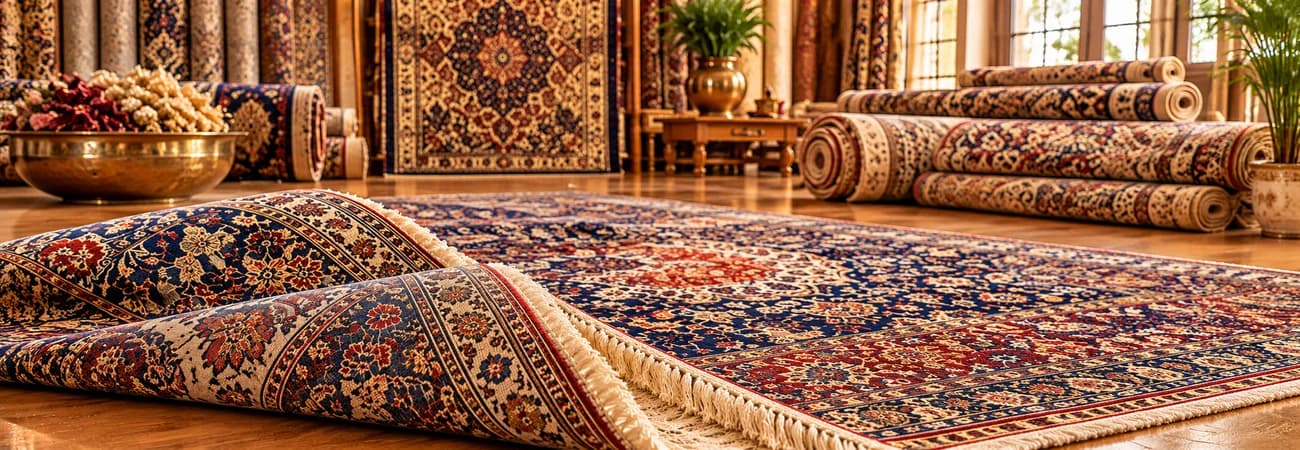
Picture it: a deep red field, an indigo medallion floating at the center, and a border that wraps the whole rug like a carved frame. You’re already imagining it in your living room. Then something snags. The price is a little too kind, or the seller goes vague when you ask where it was woven.
That hesitation is worth listening to. Rugs in this exact style are woven in India, Pakistan, China, Turkey and beyond, and plenty of them are beautiful, durable pieces. They just aren’t Persian, and they shouldn’t be priced like they are. So before you pay, it helps to know how to tell if a Persian rug is authentic, and just as important, which checks can be trusted and where each one stops being useful.
How to Tell If a Persian Rug is Authentic?
Authentic Persian rugs are the ones woven in Iran, which was called Persia for most of its history. That is the whole definition. How a rug looks and how it was knotted are separate questions. Take a rug hand-knotted in India to a Persian pattern: it’s a Persian-style rug, and selling it as one is perfectly honest.
| Type of Rug | Meaning |
| Authentic Persian Rug | Made in Iran, traditionally using Persian rug-making techniques. |
| Persian-Style Rug | Features Persian designs and patterns but may be manufactured in another country. |
| Handmade Persian Rug | Originates in Iran and is crafted by hand using traditional techniques. |
| Hand-Knotted Rug | Describes the weaving technique rather than the rug’s country of origin. |
Looks alone were never a safe test.
7 Factors to Tell If a Persian Rug is Authentic
Think of the seven checks as witnesses. Any one of them can mislead you, so you’re after a rug whose story holds together from every side. In practice, that is the answer to how to tell if a Persian rug is authentic: agreement between clues.
Check the Country of Origin
Not where it’s sold. A showroom in Delhi or London tells you nothing about the loom. Find the origin in the listing and ask the seller to confirm it in writing. A Persian pattern, on its own, says nothing about Iran.
Check out the Information
Genuine Persian carpets tend to be named after the town or area they come from, and each place has a recognisable hand.
| Region | Common Design Characteristics |
| Tabriz | Detailed floral motifs and intricate central medallions. |
| Kashan | Elaborate floral patterns, often arranged around a central medallion. |
| Isfahan | Intricate, finely detailed patterns with precise designs. |
| Nain | Fine detailing and balanced, symmetrical layouts. |
| Heriz | Bold geometric patterns and angular motifs. |
Use these as hints. Sellers also lean on regional names to describe a pattern, so “Kashan” on a tag may mean the design and not the town. There’s more background in our history of Persian rugs and carpets.
The Back of the Rug
Lift a corner. On a hand-knotted rug you can usually pick out individual knots, and the design looks almost as sharp as it does on top. Tufted and machine-made rugs read differently, flatter and more uniform. Our guide to identifying an authentic handmade carpet goes through it in detail. The catch: the back tells you how a rug was made, never where.
Motifs and Borders
Medallions, floral scrolls, layered borders, repeating geometric shapes: all of it belongs to Persian weaving, and regions favour different ones. But weavers elsewhere have used the same vocabulary for centuries, so a rug full of these motifs may still be a Persian-style rug.
Wool, Silk and Dye
Persian rugs come in wool, in silk and in blends of the two, coloured with natural or synthetic dyes. Depth of colour and small shifts in shade vary with region, period and construction, which makes them a supporting clue at best. Natural dye isn’t a guarantee, and silk is no sign of Persia.
Paperwork
This is where buyers get the most. Ask for:
- The country and region where the rug was made.
- The seller’s product description and a written statement of origin.
- Any workshop or sourcing details they hold.
- Ownership records, if the rug is old.
- Papers behind any claim about age or rarity.
Original Persian rugs should come with a trail you can follow. A generic certificate with no named issuer and nothing to check is just a piece of paper.
An Alternate Option
Pay for an independent specialist when a rug is sold as antique, when it’s expensive, when its origin is vague, or when the design, materials and sales pitch don’t add up. One visit can cover its construction, dyes, condition and provenance.
Authentic Persian Rug vs. Persian-Style Rug
| Comparison Factor | Authentic Persian Rug | Persian-Style Rug |
| Country of Origin | Made in Iran | Made in India or another country |
| Design | Features traditional Persian designs and motifs | Inspired by Persian patterns and aesthetics |
| Craftsmanship | Made using traditional techniques; may be hand-knotted or otherwise crafted | Can be handmade, hand-knotted or machine-made |
| Authenticity | Has Iranian geographical origin | Reproduces the Persian look without necessarily originating in Iran |
A Persian-style rug isn’t a lesser rug. It was simply made somewhere else, by weavers with their own training. Just hold off comparing its price with authentic Persian rugs until you know which kind you’re holding.
Questions to Ask Before You Buy
Take these along, whether you’re in a showroom or scrolling a listing and still wondering how to tell if a Persian rug is authentic:
- Was this rug made in Iran?
- Which region or weaving centre does it come from?
- Is it hand-knotted, handwoven or machine-made?
- Which materials and dyes were used?
- What can you show me that supports the stated origin?
- Has it been repaired or restored?
- Is it antique, vintage or new, and how can that be backed up?
Explore Persian Rugs at Jansons Carpets
Our Persian carpets include designs linked to the Tabriz, Kashan, Bijar, Shiraz and Nain weaving traditions. Come with your questions. And if you’re still unsure how to tell if a Persian rug is authentic, ask us about the materials, construction and origin of any piece before you decide.
At Jansons Carpets, we make it straightforward to bring genuine craftsmanship into a modern interior. As a leading carpet supplier in Delhi and carpets exporter in India, we offer a carefully curated collection across every category:
- Persian Rugs
- Kashmiri Rugs
- Afghan Rugs
- Woolen Rugs
- Wool Rugs
- Kilim Carpets
- Tribal Rugs
- Bold Geometric Rugs
- Handmade Runner Rugs
- Silk on Silk Carpets
- Vintage Inspired Rugs
- Handmade Indian Carpets
- Handmade Antique Carpets
We also provide expert carpet cleaning services and carpet restoration to ensure your carpet looks as good as new for years. If purchasing Kashmiri rugs for the first time, or in search of a wool carpet store with a wide variety of Indian carpets and rugs for commercial use, we are here to assist. If the rug and carpet difference still feels confusing, we can go through it with you.
Call us at +91 98111 29095 to talk to an expert and choose the perfect item for your space.
FAQs
Q1 . How can you tell if a Persian rug is authentic and made in Iran?
The only way to accurately determine where a Persian rug was made is by having it confirmed. The pattern and the knotting won’t be enough. But be sure to request a written statement of the country of origin, as well as the invoice and workshop details. If you are thinking about shelling out thousands on a true Persian, you might want to pay for an expert opinion, which an assured seller will provide.
Q2 . What is the difference between a Persian rug and a Persian style rug?
It just depends on where it was woven. If it’s made in Iran, then it’s a Persian rug. If it simply uses those gorgeous Persian patterns, then it’s a Persian-style rug – which can originate from India, or anywhere else that isn’t Iran. Both can be hand knotted, so be sure to ask what you’re looking at before prices.
Q3 . Is a Persian-designed hand-made rug that is India made?
Sure! They make hand-knotted Indian rugs in the Tabriz, Kashan and Nain patterns. They are Persian-style, not Iranian. An honest seller will always put that on the label. We have some in our Persian carpets collection, and if there is something you like, just inquire if they know where it was made!
Q4 . Is the back of a carpet the mark of a genuine Persian rug?
Not really. Some countries make machine-made rugs. While you can determine what country a rug was made in by looking at the back, know for sure whether it was hand-made or machine-made is best done by examining the documentation.
Q5 . Can you tell the difference between a real Persian rug and the pattern?
Not reliably. Maybe a Tabriz medallion or a Heriz geometric pattern hints at a style. But certainly those patterns were being woven outside Iran for centuries, in Mughal India. Use the pattern as a clue, but always look for written proof of origins.
Q6 . Which papers to request when buying a real persian carpet?
If it is the real value Persian rug you are looking for, get the invoice, a statement written about the country and region of origin, and the provenance of the seller. If it’s labelled antique and is limited edition, do not hesitate to ask for further documents. A reputable certificate should state who was the issuer and some verifiable information about the rug. If it sounds flimsy, it’s time for a specialist before you buy.
Q7 . Do I need an expensive Persian rug authenticated before buying?
Yes, and particularly with antique, rare, or expensive items. A pro can assess the knots, fabric, dyes, condition and origin of a rug all at one time – a listing just can’t provide all of that information. So, do inquire with the seller about inspecting the rug first – you’ll be happy that you did!