
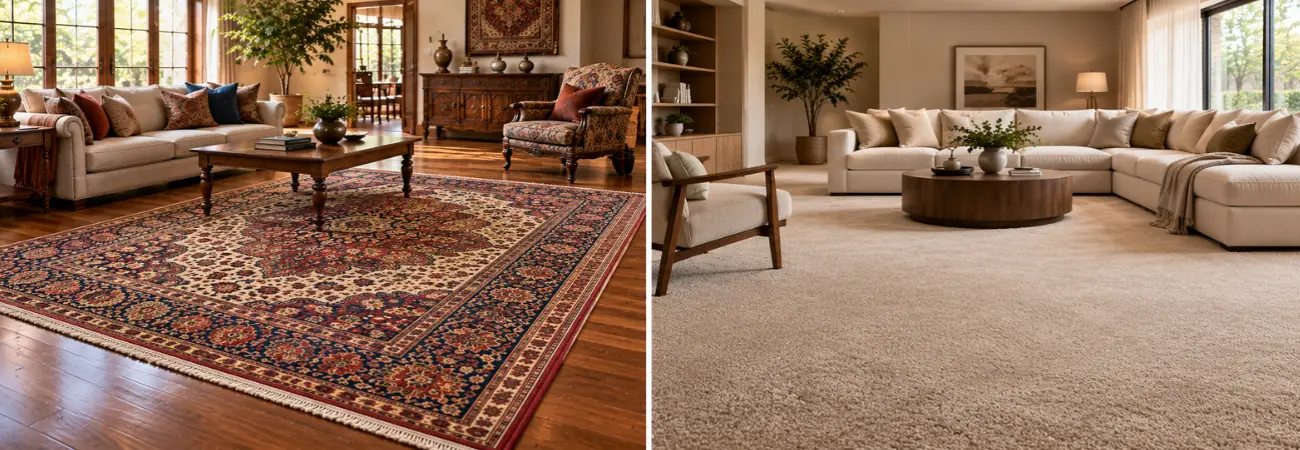
Ask for a rug in a Delhi showroom and you’ll probably be shown a carpet, and nobody will correct you. That’s why so many people search for the rug and carpet difference before they buy. The two are different, though the gap is smaller than the names imply. The real differences are floor coverage, whether someone has to fit the piece, and how easily you can change your mind later. If you’re trying to work out the rug and carpet difference for your own home, this guide takes it one step at a time.
What is the Difference between a Rug and a Carpet?
A rug is a loose covering for part of a floor. A carpet is usually bigger, and often fitted wall to wall. Then the shops muddy it. A handmade piece you could roll up and carry out under your arm still gets sold as a carpet, and in India that happens all the time, especially with hand-knotted work. One shop’s rug is the next shop’s carpet. So are rugs and carpets the same? Mostly, in everyday talk. The difference between rug and carpet is size and installation, and that’s about it. Put another way, the carpets and rugs difference is mostly about scale and how the piece is laid.
| Rug | Carpet | |
| Coverage | Part of the floor | A large area or the whole room |
| Installation | Loose, movable | Loose or fitted |
| Moving it later | Easy | Fitted ones stay with the house |
| Role in the room | Marks a zone or adds an accent | One continuous finish, or a statement piece |
Rug vs Carpet: 5 Key Differences to Consider
The table gives you the outline. Here are the five points that matter once you’re standing in the actual room with a tape measure. Each one shows the rug and carpet difference from a different angle.
1. Size and Coverage
A rug sits under the sofa and coffee table, with bare floor all around. Fitted carpet leaves none. Buyers go wrong by choosing a rug that’s too small, and the sofa ends up looking like it’s drifting. Get the front legs of the main furniture onto the rug and the room settles. Our guide to how to choose the right rug size for every room has the measurements. This is the carpets and rugs difference most people notice first. Rug size and carpet coverage are the two things to settle before anything else.
2. Installation and Flexibility
You can turn a rug around, swap it, or roll it up and take it to your next flat. Fitted carpet stays behind when you leave. There’s a grey area, too: a big handmade carpet laid loose is a rug in everything but name. That flexibility is a big part of the rug and carpet difference.
3. Style
Bold geometric rugs suit modern rooms. Silk carpets for living room use have a sheen that wool never quite manages. Handcrafted texture is having a moment in rugs trends 2026, so hand knotted rugs and vintage inspired rugs are back in favour, and layering rugs is an easy way to add depth. Fitted carpet is the quiet one. It sits under everything and doesn’t ask for attention. Style is also where the difference between carpets and rugs is easiest to see, since a rug is often the feature and a carpet is usually the backdrop.
4. Cleaning and Care
It depends on the fibre, the build, the size and whether the piece is fitted, so ask about rug and carpet maintenance for the exact piece you’re looking at. Our page on carpet and rug care covers everyday upkeep.
Natural fibres can attract carpet beetles. To get rid of carpet beetles, vacuum the edges and under the furniture, then air the piece in the sun. If they’ve already done damage, you’re into carpet washing services and carpet restoration. The difference between rug and carpet matters for upkeep too, because a loose rug can be lifted and aired outside.
5. Cost
Price follows size, material, craftsmanship and fitting. Hand-knotted carpets take [ADD YOUR DETAIL: how many weeks or months one piece takes to weave] to make, which is a big reason they cost more than machine-made ones. If price is the sticking point, see how handmade vs machine-made rugs compare. The carpets and rugs difference in price also depends on whether you’re paying for fitting. Think about how long you’ll stay put, too. A rug moves with you. Fitted carpet doesn’t.
So Which Should you Choose?
The difference between rug and carpet shows most clearly when you plan one specific room. Living room: a rug, in most cases. Put it under the front legs of the sofa and the whole group looks planned. Dining area: size it so the chairs stay on it when pulled back, because a chair leg catching the edge is annoying every single day. Bedroom: your call. Pick a rug if you like rearranging, a carpet if you want soft coverage edge to edge. A big room where you want one clean finish, no edges, no gaps, is where fitted carpet earns its place. And if you redo your rooms every couple of years, go with a rug.
So, should I choose a rug or carpet? Start with how the room is used. Rug and carpet uses overlap, but the benefits of rugs and carpets differ: rugs give you zones and easy swaps, and carpets give you one finish across the whole room. Whether you pick a rug or carpet for home use often depends on how much you rearrange. Carpet vs rug for bedroom is mostly a matter of taste.
Still can’t decide on rug vs carpet for living room or bedroom? Picture the room five years from now and choose the one you’d still want. Once you know the rug and carpet difference, each room gets easier to decide. Thinking about the balcony? Read how indoor and outdoor rugs differ first.
Types of Rugs and Carpets in India
Handmade rugs from India cover a wide range of styles, and the carpets and rugs difference also shows in how each type is made and used. Handmade rugs and carpets vary a lot in fibre and knot count, so compare pieces one by one. You’ll run into these most often:
- Persian rugs: medallions and florals, good where a room needs a focal point
- Kashmiri rugs and Kashmiri silk carpets: finely woven, with silk on silk carpets catching the light
- Afghan rugs: earthy colours, bold geometry
- Tribal rugs: irregular patterns, relaxed rooms
- Kilim carpets: flat-woven and light, easy to layer
- Woolen rugs: hard-wearing, fine for daily use
- Handmade runner carpets: narrow, for halls and bedsides
- Handmade antique carpets: an aged look for rooms that want some history
A wool carpets store usually has the widest choice of sizes.
Before you buy
Measure the room. Mark where the furniture goes. Pick a fibre that suits how you actually use the space, decide whether the piece should blend in or be the first thing guests see, and ask how it’s cleaned before you pay.
For buying Kashmiri rugs, ask about the material, the knot count and the finish. Same questions for a handmade Kashmiri rug, and for any handmade Indian carpet. Rugs and carpets differ in scale, installation, and how much freedom you want afterwards. Rugs mark out zones and travel with you. Carpets cover more floor and give one finish. In India the line is blurry anyway, so judge each piece by what it is, not what it’s called. Any good carpet shop in India should give you those details in writing. Seeing pieces side by side also makes the difference between carpets and rugs easier to judge.
At Jansons Carpets, we make it straightforward to bring genuine craftsmanship into a modern interior. As a leading carpet supplier in Delhi and carpets exporter in India, we offer a carefully curated collection across every category:
- Persian Rugs
- Kashmiri Rugs
- Afghan Rugs
- Woolen Rugs
- Wool Rugs
- Kilim Carpets
- Tribal Rugs
- Bold Geometric Rugs
- Handmade Runner Rugs
- Silk on Silk Carpets
- Vintage Inspired Rugs
- Handmade Indian Carpets
- Handmade Antique Carpets
We also provide expert carpet cleaning services and carpet restoration to ensure your carpet looks as good as new for years. If purchasing Kashmiri rugs for the first time, or in search of a wool carpet store with a wide variety of Indian carpets and rugs for commercial use, we are here to assist. If the rug and carpet difference still feels confusing, we can go through it with you.
Call us at +91 98111 29095 to talk to an expert and choose the perfect item for your space.
FAQs
Q1 . Are rugs and carpets actually different?
Yes, but mainly in terms of size and fitting, not terminology. A rug is a smaller piece of floor covering that’s portable; a carpet is bigger and often laid wall to wall. In India you’ll find shops using both words to sell hand-knotted, Kashmiri or Persian pieces – so the label won’t help you. Consider size, material and construction and if you need advice on which is best for your room, speak to the experts at Jansons Carpets.
Q2 . Is carpet or rug better for living room?
A rug, for most living rooms. It grounds the seating, reveals some flooring, and can change with your style. It’s only worth considering fitted carpet if you’re happy with one unbroken surface over a large area. Our guide to rug sizes explains the sizes for each room.
Q3 . Is it OK to put rug over carpet?
Yes, normally. Use a rug pad or anti-slip layer so it doesn’t migrate, and you don’t have ripples or frayed edges that can trip up your toes. Flat woven kilims look great over a plain fitted carpet. If your rug is wool or silk, ask us for the recommended underlay.
Q4 . Is a rug easier to maintain than a fitted carpet?
Not usually. Usually the fibre and the way it is woven and installed is more significant than the