
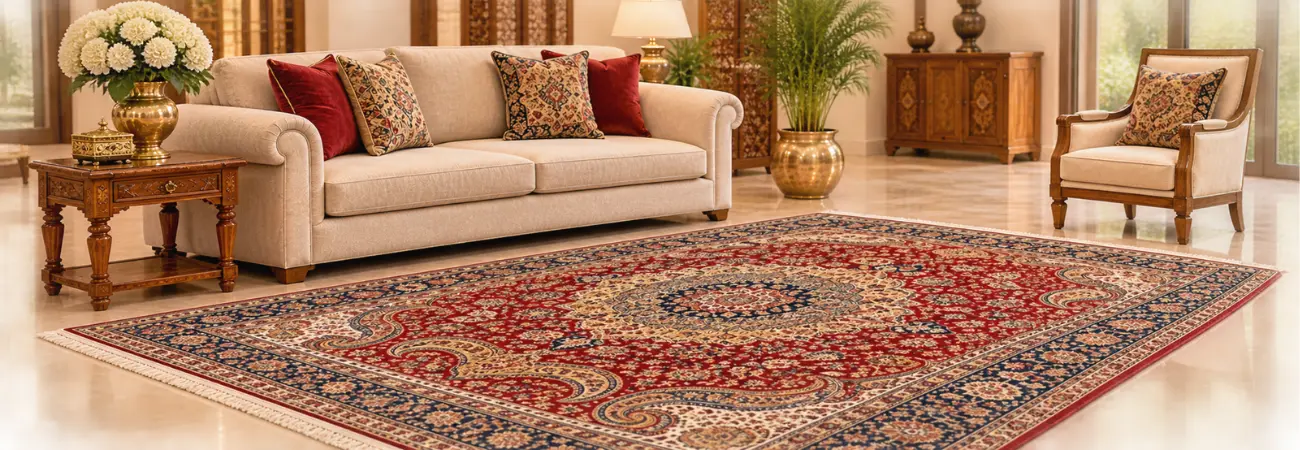
Ever looked at a Kashmiri carpet and wondered, “What is actually happening here?” Same! Most people can only name them as “floral”. But the thing is: there are specific Kashmiri carpet designs associated with Kashmiri carpets, and once you get to see them in order, you’ll realize it’s actually easier to understand them than you think. In the following, we will go through the main designs, the motifs and layouts, and how it all begins with a pencil drawing on paper and ends in a beautiful knotted carpet.
What Makes Kashmiri Carpet Designs Distinctive?
What is Kashmiri carpet design like? Kashmiri carpet designs are characterized by their classic floral arrangements, paisley motifs, interpretation of nature, and intricate borders and medallions. These have Persian, Central Asian, and Kashmiri influences, and the best Kashmiri handmade carpets carry all three. In short, Kashmir carpet design is a blend of cultures.
- Imagine one shape, like a flower or a paisley. Certain shapes (the Kashmiri carpet motifs) are repeatedly used in various combinations to create different designs on different carpets.
- Design: How those motifs are placed. For example a diamond shape or a medallion shape or an all-over design. So, two carpets might have exactly the same motifs but the layout makes it totally different.
- Overlap: Yes, a carpet can be both floral and medallion. “Floral” describes the shapes, and “medallion” describes where those shapes are.
- How it Began: 15 th century rule by Sultan Zain-ul-Abidin is said to have brought Persian & Central Asian weaving styles. Do remember treat these as Traditions and not facts.
- Persian Roots: Medallion, border, and the design of the paisley shape all have Persian roots, which Kashmiri weavers incorporated into their Kashmiri rug designs. This Persian influence on Kashmiri carpets gave rise to Persian-inspired Kashmiri carpet designs.
- Native elements: Keep an eye out for Chinar leaves and native flowers, which are often key features that make a Kashmiri carpet appear differently from a Persian one, despite a similar design.
Kashmiri Carpet Pattern Types
There’s no official list – but all sorts of Kashmiri carpet patterns and traditional Kashmiri rug patterns tend to be categorized into six broad groups. Here are the main types of Kashmiri carpet designs. Oh, and by the way: Many carpets combine two or three styles!
1. Floral and Vine Designs
Kashmiri floral carpet designs are everywhere. As Kashmiri carpets, pretty much everything is marked by the abundance of flowers.
- A field with flowers and buds connected by vines stretching through the field, adding a flow. These traditional floral rug patterns are timeless.
- Some floral carpets are simply close and formal, others are much more open and airy. One florier with the same flowers can have vastly different appearances depending on how much background there is between the flowers. These are classic floral motifs in handmade rugs.
- Border: As usually, border echoes the designs of the interior in a narrower space, providing the finishing touch to the pattern.
- If you can follow one vine for a considerable distance before it ends, it’s a floral design. (In a trellis design, the line breaks for each cell.)
2. Paisley or Buta Designs
The buta. The iconic teardrop shape, seen in most paisleys, at whatever time. Kashmiri paisley patterns are built on it.
- Size: It can be small and flannel swirled repeatedly in rows or large with a bunch of blossoms inside the envelope. Smaller scale repeats can make more uniform surface design while the larger scale ones become the center of attention. Buta motifs in Kashmiri carpets can be either.
- Origin: This is a Persian shape that also appears on Kashmiri shawls hence the Kashmiri connection.
- Names: The shapes we’re talking about go by many names, including buta, boteh, and paisley. If a seller calls it something else, don’t worry!
3. Chinar Leaf and Tree-of-Life Designs
Both of these designs draw from nature.
- Chinar Leaf: This pattern is inspired from the Chinar Tree and is similar to a broad and sharp leaf. These Chinar leaf motifs are hard to miss after you find the shape among other type of leaves.
- Position: You’ll see single leaves, strips of a line of leaves, or individual leaves dispersed along a floral field. Single leaves are used as accents while rows create bands.
- Tree of Life: Imagine a trunk and its branches, taking up the whole field, and birds if you wish, hidden in the leaves. The branches radiate out so the carpet remains unified. That is what makes tree of life carpet designs so distinctive.
- Meaning: Some sellers attach a particular symbolism to the Chinar leaf. We don’t because we’re not sure of any being authentic source, but you can certainly ask the seller the story behind theirs.
4. Central Medallion and Corner Designs
Medallion layout is the most formal of all six. Kashmiri medallion carpet designs are a good example.
- Yes, your eye goes there before drifting to the next big shape.
- The corner motifs are scaled down and repeat the shape of the medallion for a harmonious overall scheme.
- Borders: The composition will have several bands surrounding it, which are generally one stripe in width with one wider band.
- It is usually made of flowers hence confusion arises with floral patterns.
5. Geometric and Trellis Patterns
The structure of the carpet is defined by the trellis patterns, and Kashmiri geometric carpet patterns follow the same logic. If you like this look, see our Bold Geometric Rugs.
- This type has a field that divides into cells; all the cells have a small flower or leaf in them. From across the room, you can see the repeat.
- Feel: Sprawling floral carpets make the eye move all over the place. Cellular designs help calm the eye down, as there are places for it to rest.
- Pairing: Some Kashmiri carpets combine design structure with floral elements rather than separating the two completely.
6. Animal, Bird, and Nature-Inspired Designs
This is the least represented of the six.
- Subjects: Bird, animal, hunting scenes, and garden scenes, most common being birds.
- Typically: they are hidden amidst the plants and flowers rather than isolated, so the pattern maintains its overall effect.
- Time: These can take more time to draw and knot so are usually the most prominent feature on the finer carpets.
The order of the pattern in a Kashmiri carpet
There are usually five parts which constitute most of the Kashmiri carpets. Knowing them helps you read Kashmiri carpet patterns faster.
- Often seen near the centre, but not all carpets have a central Medallion.
- This is the primary place where the pattern will appear. It could be an all-over floral design or repeated with no clear center.
- Corner Motifs: For framing out the middle.
- Inner borders: These are thin patterned bands bordering the field.
- Outer Border: Usually the broadest of all. Defines the outer edge of the carpet as seen on the face.
- Corner Check: Have you ever noticed a crooked corner on a rug? That means the size was not measured properly. When a hand-made carpet is folded onto a corner, it will turn evenly. When buying a new carpet, keep that in mind for your home, and see our guide to the Right Rug Size for Every Room!
Colors in Kashmiri Carpet Designs
Here’s an interesting fact about the colors: They’re usually picked before the first knot is ever tied. Yep! It’s true! The Kashmiri’s use of color is one of the most important aspects of their carpet style, and Kashmiri carpet colours are a big part of the appeal.
Weaving Notes
And! Now, let’s discuss weaving notes. We now note each top in the weaver’s notes for each piece. This detail ensures that the weaver always has it in exactly the right spot! Who knew so much thought went into these gorgeous rugs?
Deep Palettes
For those who prefer more subdued hues, you can’t go wrong with a lighter tone in the background to give reds and blues a beautiful contrast.
Soft Palettes
Alternatively, if you want to go a little more understated, you could consider ivory and gold palettes, which are also very soft and warming.
Age
But the deal: your dark-colored rug could be new, and your light rug old. Forget color – pay attention to the fabric and the state of a carpet to figure out the age of a rug. This matters most for handmade antique carpets.
Kashmiri Silk Carpet Patterns
Silk totally flips the script on high-quality design. Kashmiri silk carpet designs are the finest example, and our Kashmiri Silk Carpets show it well.
Knot Count
Because silk can be spun so fine, more knots can be squeezed into the same space. The higher the knot count, the more points the weaver has to draw with.
Detail
Finer knots enable more delicate and intricate vines, tiny petals, and graceful bends. You can see how intricate Kashmiri silk carpet designs are, with truly intricate carpet patterns!
Light
Silk also reflects light in a way that causes the colors to change as you move by. It brings a vibrant energy to the space that you don’t want to miss.
Silk over Silk
Cotton often forms the backing of carpets, but both the pile and the backing of a Kashmiri carpet are made of silk, further enhancing the luxurious look and feel of the piece. These silk on silk carpets and Kashmiri silk rugs are prized. A handmade Kashmiri rug in silk is a real statement.
Traditional vs Contemporary Kashmiri Carpet Designs
The terminology is unchanged: flowers, paisleys, medallions and borders are still used when discussing Kashmiri carpets and Kashmiri rug designs. However the amount of those designs on the carpet, and the amount of detail, differs.
| Traditional | Contemporary |
| Intricate floral patterns and ornate borders | Simpler floral patterns and minimal borders |
| Bold, rich and high-contrast colours | Softer, muted and neutral shades |
| Detailed, decorative designs | Clean and minimal designs |
| Ideal for classic interiors | Ideal for modern interiors |
| Timeless traditional appeal | Often features vintage-inspired rug trends |
How to View a Design in Person?
A few simple tests you can do to quickly evaluate the quality of a carpet when examining one in front of you. They apply to Kashmiri hand-knotted rugs and to any hand knotted rugs or Hand-Knotted Carpets.
The Back
On a hand-knotted carpet the design should be quite obvious on the reverse as well as on the front, if it’s blurred, or totally different, that is worth questioning.
Repeats
Number a few repeats down one side. They should be evenly spaced and the same size!
Corners
Check the four corners. Sometimes a weaver’s slip will be present on only one, so check them all.
Colour
Shades should be the same with each repetition. Slight variations in one shade (abrash) are typical in handmade rugs, so don’t jump to conclusions and call it a defect.
Origin
Paisley and Medallions These motifs can also be found in Persian and other Indian carpets and do not therefore guarantee the origin of a carpet. Always ask the vendor about the origins and weave of the carpet and examine the carpet. This is especially true when buying Kashmiri rugs.
How Kashmiri Carpet Designs Are Made?
Each of the Kashmiri design begins on paper before it makes its way to the loom. This is the heart of traditional Kashmiri weaving and Kashmiri carpet craftsmanship.
Naqash
This is the designer who initially sketches the design. The drawing establishes all the motifs, borders, and colors prior to any weaving.
Talim
Next, the drawing turns into a sort of instructions to be followed. The piece of paper notes the colour and number of knots in each row, in a code that the weaver or talim reader will interpret row by row.
Weaving
The weaver keeps to the talim, often reading it aloud. It helps the knot a day in the order it needs to be, and so the pattern emerges, knot by knot.
Time
Making a fine carpet may take months. If a line is wrong, all the lines following it will be wrong. The weaver checks her talim pattern from time to time as she weaves.
Repeat Designs
The same design can be redone after several years, provided that the talim is kept. This is part and parcel of the experience of Kashmiri carpet weaving, and of Kashmiri carpet weaving traditions.
Conclusion
The symbolism of the motifs appears dense at first glance, but if you can distinguish the shapes from the layout it is easier to read. Now you can recognise the main types of Kashmiri carpet designs, and any Kashmir carpet design becomes easier to read. Study the main motifs-floral vines, buta, Chinar leaves, and, on some designs, the occasional bird-and see where they appear. And the next time you encounter a woven piece, look at the border and turn it over before you label it!
Janson Carpet is the best and largest carpet shop in India! As a trusted carpets exporter in India, we take care of each product in our collection, from Handmade Rugs from India and Handmade Indian carpets to Indian carpets and rugs of every kind. As a carpet supplier in Delhi and wool carpets store, we also offer carpet washing services and carpet restoration, and can advise how to get rid of carpet beetles. Please browse through our product range which consists of:
- Wool Rugs
- Afghan Rugs
- Tribal Rugs
- Kashmiri Silk Carpets
- Kilim Carpets
- Bold Geometric Rugs
- Persian Rugs
- Vintage-inspired Rugs
- Handmade runner carpets
So, what are you waiting for? Browse through our products at jansonscarpets.com, come to our Delhi store, or call us on +91-9811129095.
FAQs
Q1. What are the best traditional Kashmiri carpet patterns?
The best traditional Kashmiri carpet designs are floral and vine designs, paisley (buta), chinar leaves, trees-of-life and medallions. The most popular varieties are floral and medallion, and you’ll find many rugs incorporate two or three types of design.
Q2 . What does the Chinar leaf symbolize in the Kashmiri carpet design?
It comes from the Chinar trees in Kashmir and doesn’t really have a fixed meaning. It’s kinda like a pattern that is reflective of the local landscape.
Q3 . How to recognize a traditional Kashmiri carpet pattern?
Look for traditional Kashmiri rug patterns by paying attention to the design of the flowers, paisley or Chinar motifs, and the borders, and also whether or not there is a medallion. Next, make sure the back also clearly displays the design. Keep in mind that medallions and paisley are a feature of Persian Carpets, so check with the seller for further information about the provenance and materials.